
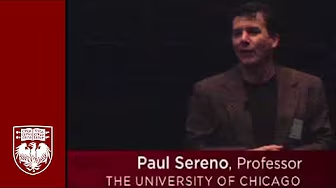
A conference celebrating the 200th anniversary of Darwin's birth, the 150th anniversary of "The Origin of Species", his most famous work and the 50th anniversary of another remarkable Darwin conference at Chicago.
خيارات ترفيهية إضافية خارج MovieBox
نبرز أيضًا وجهات شريكة لعشاق الألعاب الخفيفة والدراما القصيرة. افتح أي تجربة بضغطة واحدة.
قد يعجبك أيضًا
Masha & the Bear
Signal in catalog
Best Kids Songs, Nursery Rhymes, and Cartoon for Kids! | BabyBus
Signal in catalog
JS 1 English
Signal in catalog
Family Fun by CoComelon
Signal in catalog
SS 1 Literature
Signal in catalog
JJ & Friends by CoComelon
Signal in catalog
Baby Learning with CoComelon - Colors, Shapes and Numbers!
Signal in catalog
BabyBus | Baby Shark | Shark Songs for Kids | Shark Story
Signal in catalog
ABC Jamboree by StoryBots
Signal in catalog
Hank's Big Adventure!
Signal in catalog
Careers in business, marketing and finance
Signal in catalog
Kids Songs by CoComelon
Signal in catalog
Primary 1 English
Signal in catalog
Alphabet (ABC) Songs by CoComelon
Signal in catalog
CoComelon
Signal in catalog
CocoMelon | Little Baby Bum | Blippi - Nursery Rhymes & Kids TV Shows
Signal in catalog
CoComelon - Happy Holidays
Signal in catalog
Educational Videos for Children - Lingokids
Signal in catalog
CoComelon For Journeys
Signal in catalog
ABC Songs for Kids - CoComelon Nursery Rhymes
Signal in catalog
CoComelon Dance Party | Dance Along & Kids Songs
Signal in catalog
English lessons for kids - My English teacher
Signal in catalog
Nursery Rhymes by CoComelon
Signal in catalog
CoComelon Dance Party - Mix
Signal in catalog
التعليقات
6 تعليق
William K. Wimastt discusses the roles of ontogeny and population structure in theories of human cultural evolution. Evolutionary developmental biology now permits a richer synthesis. But no similar synthesis has occured for cultural evolution, where institutional, technological, and individual development are crucial. Earlier acquired forms tune receptivity, transformation, and transmission of later ideas and practices for individuals, deeply confounding heredity, development, and selection. But processes of generative entrenchment can yield an alternative "endogenetics" (endomemetics?), while culturally induced population structure molds development as multiple sequentially acquired skills generate a coordinate "exomemetics". Overlapping breeding populations in a "socio-ecological" network promise a richer evolutionary dynamics of cultural change than "memetics". ➡ Subscribe: About #UChicago: Since its founding in 1890, the University of Chicago has been a destination for rigorous in
The tree of life can be a tool of discovery. Armed with a knowledge of the relationships of different taxa and their distribution in the stratigraphic column, we can make predictions about the kinds of creatures yet to be discovered in the fossil record. Often these tools can be used to recover creatures with features that are intermediate between major taxa, such as between fish and limbed animals. Interestingly, a knowledge of the fossil record, when placed in a phylogenetic context, suggests experiments in molecular biology by enabling predictions of the kinds of genes and pattern-forming processes that exist in basal taxa. This ability to use different lines of data as tools to predict discovery in each field is a demonstration of the power of the information contained in the tree of life. ➡ Subscribe: About #UChicago: Since its founding in 1890, the University of Chicago has been a destination for rigorous inquiry and field-defining research. This transformative academic experienc
Darwin's gradualism required that the fossil record's imperfections be emphasized in the Origin, but paleontological data are robust for many questions, and can provide crucial insights into many large-scale evolutionary questions. Enlarged temporal and spatial scales reveal evolutionary patterns and processes that are virtually inaccessible to, and unpredictable from, short-term, localized observations. These larger-scale phenomena range from evolutionary stasis at the species level and the mosaic assembly of complex morphologies in ancestral forms to the non-random temporal and spatial distribution of the origin of major evolutionary novelties and clades. Extinction, particularly clade-specific extinction, is the Achilles' heel of many neontological approaches to reconstructing evolutionary processes, from diversity-dependence of evolutionary dynamics to the assembly and consequences of key innovations. Paleontological data both fill these gaps and drive novel research programs on ev
The iconic Darwin to whom most contemporary biologists look, including several of my colleagues at this conference, is not identical to the historical Darwin, the author of the Origin of Species. The iconic Darwin produced a theory that is non-progressivist and abandons all teleological assumptions about biological development. For this symbolic Darwin, natural selection operates mechanically to effect only opportunistic alterations, and so the evolutionary process lacks any directional force. Unlike the nature of old, guided by Divine intent, neo-Darwinian nature has no purpose. I believe the historical Darwin to be quite other than his neo-Darwinian Doppelganger. The historical Darwin constructed nature as displaying intelligent forethought; and he conceived natural selection to operate with purpose, ultimately to produce moral individuals, namely us. He thus construed evolution to be progressive, attaining ever higher levels of perfection, culminating in advanced civilization. Why h
In 2004, Allen Orr and I summarized the history of work on speciation and what it told us about nature. The ensuing five years has seen a flurry of work on the topic, encompassing molecular biology, natural history, genetic analysis, and even philosophy. This talk updates what I see as the important -- and tractable -- questions about speciation. ➡ Subscribe: About #UChicago: Since its founding in 1890, the University of Chicago has been a destination for rigorous inquiry and field-defining research. This transformative academic experience empowers students and scholars to challenge conventional thinking in pursuit of original ideas. #UChicago on the Web: Home: News: Facebook: Twitter: Instagram: University of Chicago on YouTube: /uchicago *** ACCESSIBILITY: If you experience any technical difficulties with this video or would like to make an accessibility-related request, please email digicomm@uchicago.edu.
Paul Sereno talks about dinosaurs at the Darwin / Chicago 2009 Conference ➡ Subscribe: About #UChicago: Since its founding in 1890, the University of Chicago has been a destination for rigorous inquiry and field-defining research. This transformative academic experience empowers students and scholars to challenge conventional thinking in pursuit of original ideas. #UChicago on the Web: Home: News: Facebook: Twitter: Instagram: University of Chicago on YouTube: /uchicago *** ACCESSIBILITY: If you experience any technical difficulties with this video or would like to make an accessibility-related request, please email digicomm@uchicago.edu.