
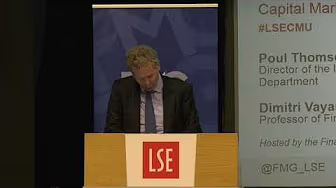
A collection of videos from the Financial Markets Group.
خيارات ترفيهية إضافية خارج MovieBox
نبرز أيضًا وجهات شريكة لعشاق الألعاب الخفيفة والدراما القصيرة. افتح أي تجربة بضغطة واحدة.
قد يعجبك أيضًا
Numberblocks Season 8
Signal in catalog
Film Indonesia
Signal in catalog
SSS10 Other
Signal in catalog
JSS9 Other
Signal in catalog
Test Your English with TV Series and Movies
Signal in catalog
Go Figure
Signal in catalog
Kids Songs by CoComelon
Signal in catalog
Baby Learning with CoComelon - Colors, Shapes and Numbers!
Signal in catalog
CoComelon
Signal in catalog
Alphabet (ABC) Songs by CoComelon
Signal in catalog
CocoMelon | Little Baby Bum | Blippi - Nursery Rhymes & Kids TV Shows
Signal in catalog
SS 2 Mathematics
Signal in catalog
Charlie and Lola Full Episodes
Signal in catalog
How to Be a Better Human
Signal in catalog
Recent videos we think you’ll love
Signal in catalog
New Compilations | Chuggington
Signal in catalog
Learn English With Disney Movies
Signal in catalog
CoComelon #shorts
Signal in catalog
All New Akili & Me
Signal in catalog
Educational Cartoons for Kids | Learn with Sheriff Labrador
Signal in catalog
JoJo and Gran Gran
Signal in catalog
KS2 Drama
Signal in catalog
SS 1 Physics
Signal in catalog
Nursery Rhymes & Kids Cartoon (All!!) | Kiki and Miumiu | Baby Shark | Fire Truck | Top Playlist - Nursery Rhymes & Kids Songs by BabyBus
Signal in catalog
التعليقات
10 تعليق
Professor Renée Adams discusses the myths and facts surrounding women's participation on Corporate Boards.
In the aftermath of Pfizer's failed takeover attempt, Professor Daniel Ferreira interviews Professor David Kershaw, who is an expert on UK takeover rules, about the role of such rules on the outcome of the proposed deal.
Contributors: Dr Tom Kirchmaier and Dr Hans-Christoph Hirt Dr Tom Kirchmaier talks to Dr Hans-Christoph Hirt surrounding the differing problems surrounding Corporate Governance in Emerging Markets, and introduces a new series that looks into the various aspects of it. It will be followed by a longer debate held in Hong Kong later on in the year.
Corporate Governance in Emerging Economies – View from India Contributors - Nimesh Kampani; Chairman, Confederation of India Industry’s National Committee on Financial Markets; Chairman, JM Financial Group Dr Tom Kirchmaier, Corporate Governance at LSE
Corporate Governance in Emerging Economies – a Lost Cause? Contributors - Gary Greenberg, Head of Emerging Markets, Hermes Investment Management Dr Tom Kirchmaier, Corporate Governance at LSE
Corporate Governance in Emerging Economies – View from China Contributors - Dr Hans Hirt, Executive Director, Hermes Investment Management; Research Associate, Corporate Governance at LSE Michael Cheng, Research Director, China & Hong Kong, Asian Corporate Governance Association Professor Wei Shen, Shanghai Jiaotong University Dr Tom Kirchmaier, Corporate Governance at LSE
Chris Hodge shares his opinion about what other countries can learn from the UK experience when introducing Governance frameworks.
Are bankers overpaid? Professor Ulf Axelson argues that high pay levels in finance may be necessary to prevent misconduct, even if the lucky few landing these jobs are no more skilled or deserving than others. Contributors: Professor Ulf Axelson, Dr Tom Kirchmaier For more information, please visit:
What has caused the massive growth in CEO compensation? Prof Dirk Jenter presents historical evidence and explains that market forces are the most likely cause of the rise in CEO compensation. Contributors: Prof Dirk Jenter, Dr Tom Kirchmaier
The authors discuss the British regulation of executive remuneration, which is characterised by the unique feature of two votes, one forward looking on the company’s remuneration report, and one backward looking on the director’s annual remuneration package. Using the pay information disclosed by FTSE 100 companies, research shows that shareholders guide their vote by top line salary and appear to disregard the remaining substantial body of information provided to them. Shareholders differentiate between the two voting dimensions in about 23% of the cases. In contrast to the rationale of the legislation that introduced the two votes, however, differentiating voting behaviour is not driven by characteristics of the executive’s remuneration policy, but mainly by exceptionally positive future performance expectations. Contributors: Dr Carsten Gerner-Beuerle and Dr Tom Kirchmaier