
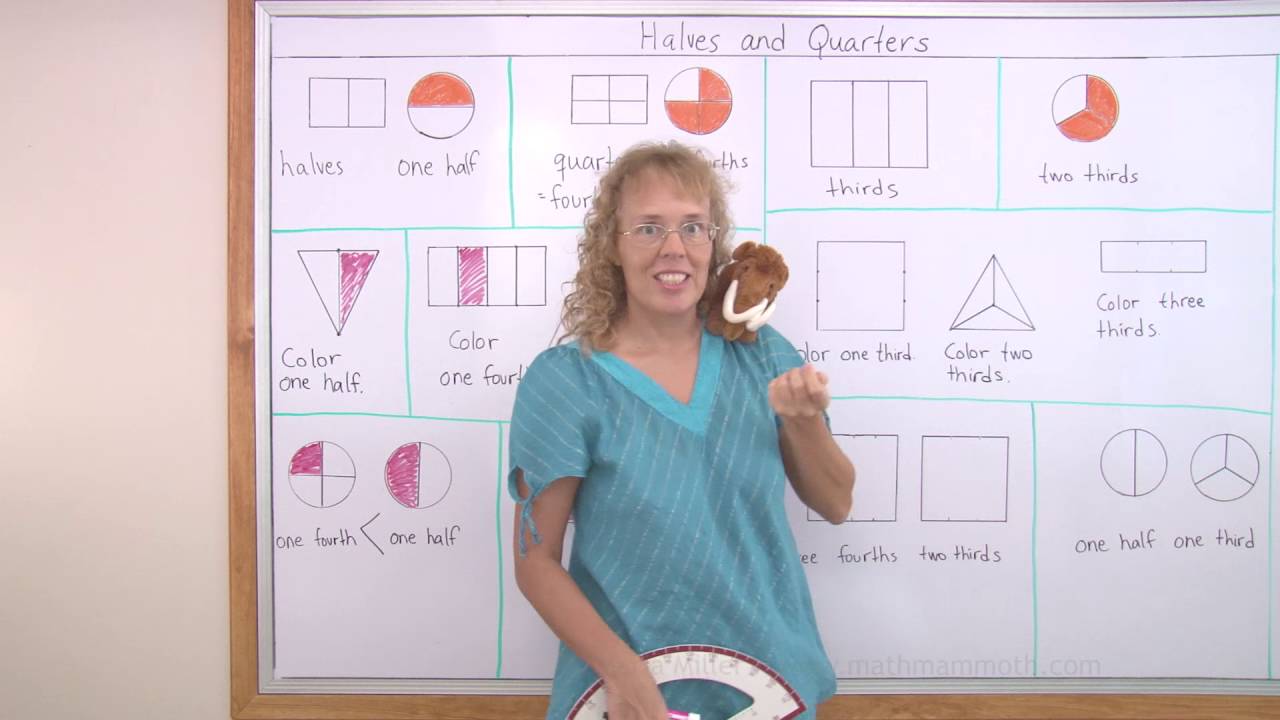
In this easy lesson, we don't yet study the fraction notation, but just learn the concepts related to halves, thirds, and fourths (quarters). I show these by coloring in the corresponding parts. We also compare two given fractions by coloring. It's basically pretty fun! Fractions don't need to be difficult, scary "monsters" at all! Check out my other videos at and my fraction workbook at
Entertainment picks lampas sa MovieBox
May mga partner destination din kami para sa fans ng casual games at short drama. Buksan ang alinman sa isang tap lang.
Maaari Mo Ring Magustuhan
Primary 1 English
Signal in catalog
Alphabet (ABC) Songs by CoComelon
Signal in catalog
CocoMelon | Little Baby Bum | Blippi - Nursery Rhymes & Kids TV Shows
Signal in catalog
CoComelon - Happy Holidays
Signal in catalog
Kids Songs by CoComelon
Signal in catalog
CoComelon
Signal in catalog
ABC Songs for Kids - CoComelon Nursery Rhymes
Signal in catalog
English lessons for kids - My English teacher
Signal in catalog
PrePrimary Maths
Signal in catalog
Year1 Maths
Signal in catalog
Year 11 Math
Signal in catalog
Year2 Maths
Signal in catalog
Numberblocks Fun! | Learn To Count | @Numberblocks
Signal in catalog
Numberblocks - Homeschooling #Stayhome ✏️📘
Signal in catalog
Numberblocks - How to Count to Ten | Learn to Count
Signal in catalog
Primary 1 Maths - Number Patterns
Signal in catalog
Math Videos for Kids
Signal in catalog
Functions and their graphs | Algebra II | Khan Academy
Signal in catalog
Trigonometry | High School Math | Khan Academy
Signal in catalog
FBISE Maths
Signal in catalog
Preschool and Kindergarten
Signal in catalog
Year 6 Math
Signal in catalog
3rd Grade Fractions
Signal in catalog
Math on the Rocks
Signal in catalog
Mga Komento
8 Mga Komento
We study simple fractions, such as halves, thirds, and fourths, and how to write those with the proper fraction notation. Then, we look at rectangles on a grid - in other words, with "little squares". We divide such rectangles into fractional parts, such as thirds or fourths, and then check how many "little squares" are in the fractional part versus in the whole. This is of course preparing students for the concepts of AREA (studied in 3rd grade) and finding a fractional part of a quantity. We still get to do lots of coloring and things are done with visual models (concrete), so this is not anything difficult! Check out also my other videos at
We study simple fractions, such as halves, thirds, and fourths, and how to write those with the proper fraction notation. Then, we look at rectangles on a grid - in other words, with "little squares". We divide such rectangles into fractional parts, such as thirds or fourths, and then check how many "little squares" are in the fractional part versus in the whole. This is of course preparing students for the concepts of AREA (studied in 3rd grade) and finding a fractional part of a quantity. We still get to do lots of coloring and things are done with visual models (concrete), so this is not anything difficult! Check out also my other videos at
This lesson focuses on finding ONE-HALF of a given number and also ties in this concept with the process of DOUBLING. We start out by using visual models to find half of 12, half of 14, and half of 48. Then, I show how finding the double of a number is the OPPOSITE of finding half of a number. Lastly we solve some word problems. A ready-made doubles chart helps us with that. Check out also my other 2nd grade math videos at
This lesson focuses on finding ONE-HALF of a given number and also ties in this concept with the process of DOUBLING. We start out by using visual models to find half of 12, half of 14, and half of 48. Then, I show how finding the double of a number is the OPPOSITE of finding half of a number. Lastly we solve some word problems. A ready-made doubles chart helps us with that. Check out also my other 2nd grade math videos at
We compare simple fractions by using visual models (pies or rectangles). In the end, I ask an interesting question about 1/2 of a rectangle cut one way, versus 1/2 of a rectangle cut another way - which will be the bigger piece? Children might not intuitively know that 1/2 of a rectangle will be equal to 1/2 of a rectangle, now matter how it is cut, but I show, using quarters, that the pieces must be equal in size. Check out also my other videos at
We compare simple fractions by using visual models (pies or rectangles). In the end, I ask an interesting question about 1/2 of a rectangle cut one way, versus 1/2 of a rectangle cut another way - which will be the bigger piece? Children might not intuitively know that 1/2 of a rectangle will be equal to 1/2 of a rectangle, now matter how it is cut, but I show, using quarters, that the pieces must be equal in size. Check out also my other videos at
In this easy lesson, we don't yet study the fraction notation, but just learn the concepts related to halves, thirds, and fourths (quarters). I show these by coloring in the corresponding parts. We also compare two given fractions by coloring. It's basically pretty fun! Fractions don't need to be difficult, scary "monsters" at all! Check out my other videos at and my fraction workbook at
In this easy lesson, we don't yet study the fraction notation, but just learn the concepts related to halves, thirds, and fourths (quarters). I show these by coloring in the corresponding parts. We also compare two given fractions by coloring. It's basically pretty fun! Fractions don't need to be difficult, scary "monsters" at all! Check out my other videos at and my fraction workbook at