
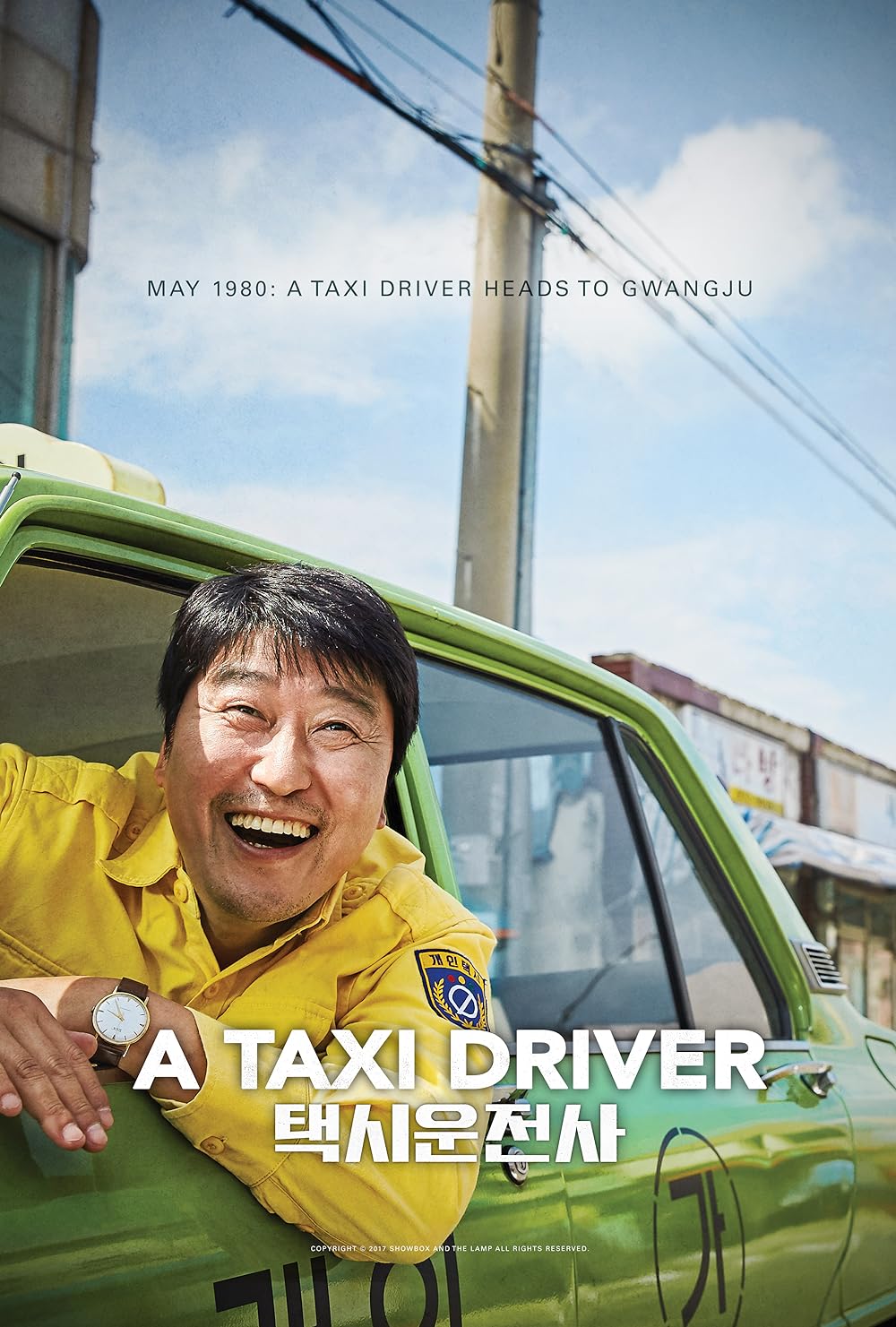
Un père veuf et chauffeur de taxi qui conduit un journaliste allemand de Séoul à Gwangju pour couvrir le soulèvement de 1980 regrette vite sa décision quand il se retrouve mêlé à la violence des évènements.
Bande-annonce
Casting
Song Kang-ho
Kim Man-seob
Thomas Kretschmann
Jürgen Hinzpeter
Yoo Hae-jin
Hwang Tae-sul
Ryu Jun-Yeol
Gu Jae-sik
Hyuk-kwon Park
Reporter Choi
Gwi-hwa Choi
Civvies leader
Cha Soon-bae
Driver Cha
Sin Dam-soo
Driver Sin
Seong-hyeon Ryoo
Driver Ryoo
Tae-goo Eom
Illegal checkpoint Sergeant First Class Park
Min-hee Park
Kwon Joong-ryeong
Jung-Eun Lee
Hwang Tae-sool's wife
Eun-mi Yoo
Kim Eun-jeong
Kwon Soon-Joon
Kang Sang-goo
Yoon Seok-ho
Hwang Tae-sool's son
Heo Jung-do
Pregnant woman's husband
Lee Bong-ryun
Pregnant Woman
Lee Ho-Cheol
Hong Yong-pyo
Des idées divertissement au-delà de MovieBox
Nous mettons aussi en avant des destinations partenaires pour les fans de jeux casual et de mini-dramas. Ouvrez l'une ou l'autre en un clic.
Vous aimerez aussi
Red Notice
Signal in catalog
Black Panther: Wakanda Forever
Signal in catalog
Les Trois Mousquetaires
Signal in catalog
Cobra Kai
Signal in catalog
La casa de papel
Signal in catalog
Off Campus
Signal in catalog
La Reine Charlotte: Un chapitre Bridgerton
Signal in catalog
Power Book IV: Force
Signal in catalog
Man on Fire
Signal in catalog
Forever
Signal in catalog
The Cleaning Lady
Signal in catalog
Généra+ion
Signal in catalog
Sex Education
Signal in catalog
Emily in Paris
Signal in catalog
Squid Game
Signal in catalog
Iron Fist
Signal in catalog
Outlaws
Signal in catalog
Lukkhe
Signal in catalog
New York - Unité spéciale
Signal in catalog
Heeramandi: The Diamond Bazaar
Signal in catalog
9-1-1
Signal in catalog
Grimm
Signal in catalog
The Rookie : Le flic de Los Angeles
Signal in catalog
Esprits criminels
Signal in catalog
Commentaires
8 commentaires
action
I enjoyed this movie. It was fairly tight, well-written and photographed. I would've said it was an 8 were it not for the overwhelming Korean trope of super oppressive background strings and buckets of crocodile tears. These distracting aspects weaken an otherwise strong and compelling film. I think by now I must've seen at least 10 films that stars Kong-ho Song, including the Oscar favorite "Parasite". Ne never fails to deliver, that's for sure. I just wish the dang directors wouldn't always go for the tear factor, though. It always look ridiculous, especially in this political film where the German journalist himself gets reduced to tears because it's in the script. Ridiculous.
1980 Gwangju is no small matter to many Korean people. You can compare it to Kennedy assassination in its significance. I had a high expectation because of the subject matter and the actors, but I felt that the movie fell short. The direction and writing were rather poor considering the named actors and quite high production value. The acting was good, but not stellar. Should be shorter and smoother in transition. Of course, I enjoyed it 1000 more than those soul-less CG-intense transformer series.
The DIALOG, man. What made us not easy to enjoy the Korean movies or the TV drama series, no matter how popular they are, is the stupid dialog. It's not the normal dialogs that we usually see in the Western movies, the dialog in Korean movies or drama series are not dialog between two characters or among several actors, but a monologue, a single person keeps talking to himself or herself, and such monologue is widely used to show those thoughts usually flow in one's brain. But Korean movies and TV dramas use such stupid monologue, a self-talking-to-himself(herself) to let the viewers, who in the eyes of the screenplay writers and the directors usually think the viewers are too stupid to understand what the characters in the movie or TV dramas are thinking. So most of the time in a Korean movie ( the Japanese movies and TV dramas also got such problem, but not as serious as the Korean's), talking non-stop to him(her)self, a monologue only mentally ill or born retarded, become the never-can-get-rid-of, must-have, even in self doubt scene so popularly used. A dialog helps the viewers to understand the on-going of the storyline, the coming-up or developing scenarios or plots, but use monologue of one person keeps talking to himself or herself is just stupid and unnatural. When people start talking to himself or herself, it's a popular sign and common sense that the person who talk or murmuring to himself(herself) is reaching a deteriorating mental condition, he or she uses the mouth to carry out the thoughts in their mind or brain. It's a common symptom of aging problem. People under age 45 usually would not have such self-murmuring problem unless a mentally deterioration is underway. But the Korean movies and TV dramas both pushing the uncontrollable talking to himself or herself a common habit to all the Koreans, no matter young or old, male or female, they all put their thoughts, their thinking in their mouths and blabbering out non-stop. If the Koreans got such talk-to-themselves problems when they are still young, even at teenage, I just could not imagine how such problem would become how serious when they become older and older. We often saw some people talking to themselves in a supermarket or in the street, and we'd automatically consider them either too old or with mental problems, but not the Koreans, especially the Koreans in a Korean movie or TV drama, because to the Korean people, the monologue is indeed the dialog. We've seen so many good Korean movies and TV drama series, almost all of them got such ridiculous talking-to-himself or herself. Dialog is a conversation, not a monologue, consciously, sub-consciously or unconsciously to show one's thoughts by mouth.
In China, we had the same movement, but we failed. We still live in the control of Chinese Communist Party. Why did we fail in 4th June 1989? What should we do for our freedom?