
Title Matrix
Lines of Thought: Discoveries that Changed the World
Pilihan hiburan di luar MovieBox
Kami juga menampilkan partner untuk penggemar game kasual dan short drama. Buka salah satunya hanya dengan satu ketukan.
Mungkin Anda Juga Suka
SEAS Videos
Signal in catalog
Introduction to HTML, CSS, & JavaScript
Signal in catalog
6º ANO | ENSINO FUNDAMENTAL 💚
Signal in catalog
Kids Songs & Nursery Rhymes | CoComelon, Blippi & Little Angel
Signal in catalog
Chinese for HSK 2
Signal in catalog
5 EASIEST Ways to Make Money With AI (No One is Doing This)
Signal in catalog
Careers in art, fashion and design
Signal in catalog
Chinese for HSK 1
Signal in catalog
Sesame Street Korean | 세서미 스트리트 한국어
Signal in catalog
CoComelon
Signal in catalog
ABC Songs for Kids - CoComelon Nursery Rhymes
Signal in catalog
SEAS Graduate Students
Signal in catalog
Data Science Methodology
Signal in catalog
Nastya and papa
Signal in catalog
Careers in business, marketing and finance
Signal in catalog
Vlad and Niki learn cooking
Signal in catalog
Netflix Jr Toy Play
Signal in catalog
Excel Basics for Data Analysis
Signal in catalog
ABCs, 123s, and MORE with Sesame Street and The Children's Kingdom Nursery Rhymes
Signal in catalog
Diwali Mela 2025 | SGT University
Signal in catalog
Like Nastya and Halloween stories.
Signal in catalog
Toddlers & PreK Learning
Signal in catalog
Python for Class 12 (Apni Kaksha)
Signal in catalog
ABC Songs
Signal in catalog
Komentar
7 Komentar
Cambridge University Library is celebrating its 600th anniversary with an exhibition of priceless treasures communicating 4,000 years of human thought. Featuring iconic works by Newton, Darwin and Shakespeare, Lines of Thought traces the connections between some of the most important books and manuscripts in history.
Cambridge University Library is celebrating its 600th anniversary with an exhibition of priceless treasures communicating 4,000 years of human thought. To celebrate, we have made six films on the six distinct themes featured in Lines of Thought. Our first film looks at revolutions in communications, taking us from 3000-year-old Chinese oracle bones to Penguin paperbacks of the 20th century – via the Gutenberg Bible and the earliest known Scottish manuscript. These are the words that changed the world.
Cambridge University Library is celebrating its 600th anniversary with an exhibition of priceless treasures communicating 4,000 years of human thought. To celebrate, we have made six films on the six distinct themes featured in Lines of Thought. The second film in the series looks at Gravity; by following the discussions of generations of great scientific minds, from Copernicus to Hawking via Newton and Einstein, we begin to understand our place among the stars. To see more of the exhibits in this theme, visit the Virtual Exhibition:
Cambridge University Library is celebrating its 600th anniversary with an exhibition of priceless treasures communicating 4,000 years of human thought. To celebrate, we have made six films on the six distinct themes featured in Lines of Thought. The third film in the series looks at the translation of some of the Library’s most important religious texts. Translation has always been central to the transmission of faith across barriers of religion and culture, but could be a perilous activity. William Tyndale’s English translation of the New Testament ultimately cost him his life. Today’s academics are exploiting digital technology to unearth new secrets from documents penned in antiquity. Cutting-edge multispectral imaging allows us to read texts erased from the seventh-century manuscript of the Gospel of Saint Luke featured in our new film.
The idea that characteristics could be passed from one generation to another was crucial to Charles Darwin’s theory of how new forms of life develop. In the 1950s the structure of DNA, the compound that encodes genetic information, was finally deciphered by Francis Crick, James Watson, Rosalind Franklin and Maurice Wilkins, all of whom were working in or trained in Cambridge. Cambridge University Library is celebrating its 600th anniversary with an exhibition of priceless treasures communicating 4,000 years of human thought. To celebrate, we have made six films on the six distinct themes featured in Lines of Thought. Credits: University Museum of Zoology Darwin images - By kind permission of the Darwin family Rosalind Franklin manuscript - By kind permission of Jenifer Glynn Francis Crick PhD - By kind permission of Gabrielle Crick Watson and Crick portrait - Photographed by Antony Barrington Brown (Caius 1948) at Gonville & Caius College, Cambridge. Reproduced by permission of the Mas
A hand-coloured copy of Vesalius’ 1543 Epitome – one of the most influential works in western medicine – and the first written record of a dissection carried out in England are among the objects in our latest film celebrating Lines of Thought at Cambridge University Library. Since March, some of the world’s most valuable books and manuscripts have been on display as Cambridge University Library celebrates its 600th birthday with a once-in-a-lifetime free exhibition of its greatest treasures. The objects in Lines of Thought: Discoveries that Changed the World, which will close to the public on September 30, communicate 4,000 years of human thought through the Library’s unique and irreplaceable collections. More than 70 per cent of the exhibits are displayed to the public for the first time. The exhibition investigates through six distinct themes how Cambridge University Library’s eight million books and manuscripts have transformed our understanding of life here on earth and our place a
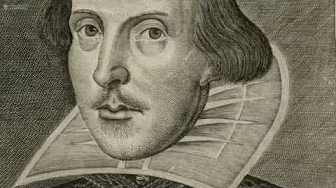
Shakespeare's 'First Folio', Dante's Divine Comedy, and fragments of Homer's Odyssey from the second century CE, are among the objects in our latest film celebrating Lines of Thought at Cambridge University Library. A hand-coloured copy of Vesalius’ 1543 Epitome – one of the most influential works in western medicine – and the first written record of a dissection carried out in England are among the objects in our latest film celebrating Lines of Thought at Cambridge University Library. Since March, some of the world’s most valuable books and manuscripts have been on display as Cambridge University Library celebrates its 600th birthday with a once-in-a-lifetime free exhibition of its greatest treasures. The objects in Lines of Thought: Discoveries that Changed the World, which will close to the public on September 30, communicate 4,000 years of human thought through the Library’s unique and irreplaceable collections. More than 70 per cent of the exhibits are displayed to the public for