
Videos made with Professor Robert (Bob) Spence of Electrical Engineering
Pilihan hiburan di luar MovieBox
Kami juga menampilkan partner untuk penggemar game kasual dan short drama. Buka salah satunya hanya dengan satu ketukan.
Mungkin Anda Juga Suka
CoComelon Learn ABCs #Shorts!
Signal in catalog
ChuChu & Friends in Storytime Adventures - ChuChu TV
Signal in catalog
Letters and Letter Sounds
Signal in catalog
Happy Holidays from Netflix Jr!
Signal in catalog
Kids Songs by CoComelon
Signal in catalog
CoComelon
Signal in catalog
Alphabet (ABC) Songs by CoComelon
Signal in catalog
CocoMelon | Little Baby Bum | Blippi - Nursery Rhymes & Kids TV Shows
Signal in catalog
Learn English With Disney Movies
Signal in catalog
All New Akili & Me
Signal in catalog
Charlie and Lola Full Episodes
Signal in catalog
🎮⭐ Play & Watch | Trailers and Gameplays
Signal in catalog
Sleepytime! 💤 | Learn Words with Yakka Dee |BBC Kids
Signal in catalog
English with TV Series (Kids Appropriate)
Signal in catalog
Year5 Music
Signal in catalog
African
Signal in catalog
Test Your English with TV Series and Movies
Signal in catalog
Diverse@Imperial
Signal in catalog
SS 3 Mathematics
Signal in catalog
The Original CoComelon Alphabet Series
Signal in catalog
CoComelon #shorts
Signal in catalog
Educational Cartoons for Kids | Learn with Sheriff Labrador
Signal in catalog
Sheriff Labrador New Episodes
Signal in catalog
🎃🕯️🧛♀️ HALLOWEEN STORIES 2025 🕷️🧹👻
Signal in catalog
Komentar
10 Komentar
5th Colin Cherry Memorial Lecture on Communication, given by Professor Robert Spence, Imperial College London.
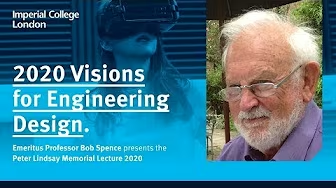
In 1994 Professor Robert Spence interviewed twelve eminent engineering designers to elicit their visions about the nature of engineering design in the year 2020, twenty-five years later. To present these visions to a wide public Professor Spence produced a video called Translations, showing a dinner party taking place in the year 2020, the dinner guests being leading engineering designers of that time. Interestingly, although the subject of discussion was engineering design, many of the visions basically concerned human-computer interaction.
Professor Robert Spence demonstrates the bifocal display
Bob Spence's research has ranged from engineering design to human-computer interaction and often with the manner in which the latter can enhance the former. Notable contributions, usually in collaboration with colleagues, include the powerful generalized form of Tellegen's Theorem; algorithms for improving the manufacturing yield of mass-produced circuits; and, in the field of Human-computer Interaction, the invention of the first focus+context technique, the Bifocal Display (aka Fisheye lens). The novel Attribute and Influence Explorers provide examples of novel information visualization tools that have wide application, including engineering design. Interactive computer graphics allows the electronic circuit designer to sketch the familiar circuit diagram on a computer display. This potential was pioneered by Bob and his colleagues in the late 1960s and eventually, in 1985, led to the commercially available MINNIE system developed and marketed by a company of which Bob was chairman a
With colleagues, Bob Spence had devised MINNIE allowing a circuit designer to describe a circuit by drawing it on a screen. Using a 'light pen' to interact with the screen, circuits could be created and modified. The most interesting artifacts (as Bob calls them) were the "on screen pocket calculator" (1973) and the "count-down clock" indicating the process time. The on-screen calculator is thought to be the first in the World and both these functions are now common place. For more:
1975 live demonstration of the computer language APL (A Programming Language) by Professor Bob Spence, Imperial College London. Bob joined the staff of Imperial College in the 1962 and is now Professor Emeritus in EEED. His field of work has ranged from engineering design, to human-computer interaction (HCI) and along the way is credited with the invention of the first 'focus+context' technique, the Bifocal Display (aka Fisheye lens) featured in another video. For more:
A re-digitised version of this important video made in 1981. The full title of this video is- Focus on Information: The Office of the Professional By 1980 the idea of 'focus+content' had been identified and a solution called the Bifocal Display created, in mock-up form anyway. Bob Spence wanted to create a video to show this and other concepts to a wider audience. Videotape was a solution to this. So, just before Christmas in 1980 a video (which is now credited as being the first ever 'envisionment video'), "Office of the Professional" was made. Bill Buxton in his 2007 book ‘Sketching user experiences’ is quoted as saying, in reference to the video, “….is the first example of envisionment videos that I am aware of….” and “….remarkable for its insights…and two years before the launch of the Apple Macintosh.” For more:
Recorded in 1997 this lighthearted discussion on college life, is between Colin Vickery and Bob Spence and is centred on the years from 1952 onwards Colin Vickery was, at the time of the interview, running a postgraduate section on microprocessor applications. He was not going to be available for some of the proceedings of an Alumni event, so Bob interviewed him on video. Bob Spence and Colin Vickery had shared a flat during the time they were doing PhDs under Roy Boothroyd who was Prof Colin Cherry's Reader. Read more:
Professor Spence’s research has ranged from engineering design to human-computer interaction,and often with the manner in which the latter can enhance the former. Notable contributions, usually in collaboration with colleagues, include the powerful generalized form of Tellegen’s Theorem; algorithms for improving the manufacturing yield of mass-produced circuits; and, in the field of Human-computer Interaction, the invention of the first focus+context technique, the Bifocal Display (aka Fisheye lens). The novel Attribute and Influence Explorers provide examples of novel information visualisation tools that have wide application, including engineering design. For more information please read the blog:
In 1995 Bob Spence interviewed 12 respected engineers to elicit their visions of engineering design 25 years later, in 2020. In his Peter Lindsay Lecture "2020 Visions for Engineering Design" Bob will review some of those visions to see what can be learned from them, and will present some thoughts as to how features of human cognition and perception might be triggers for new visions