
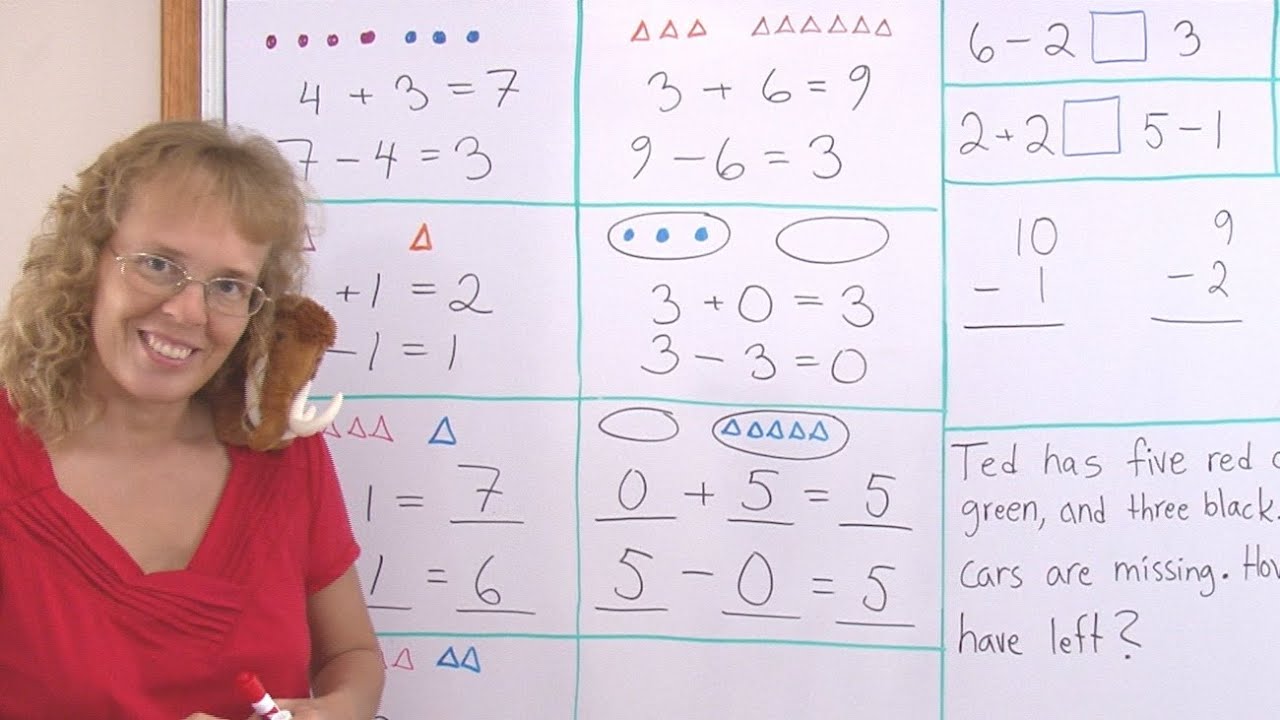
A lesson for 1st grade math... learn the CONNECTION between addition and subtraction in an easy way! Just look at the PICTURE. We have a picture with, say, 4 raspberries and 3 blueberries. From that, we can write an addition of course -- but we can ALSO write a subtraction! We just make the one part (4) or the other (3) "go away". In the latter part of this lesson, we also look at "alligator mouth" problems -- or, like Mathy likes to call them, "mammoth mouth" problems. We compare simple expressions, such as 2 + 2 and 5 - 1, and figure which one is greater than the other. Then we solve some simple subtractions. Lastly, I give a challenging word problem concerning Ted's cars, and we solve it by DRAWING.
MovieBox سے آگے بھی entertainment picks
ہم casual games اور short drama پسند کرنے والوں کے لیے partner destinations بھی دکھاتے ہیں۔ کسی بھی تجربے کو ایک ٹیپ میں کھولیں۔
آپ کو یہ بھی پسند آ سکتا ہے
Kids Songs by CoComelon
Signal in catalog
Learn Colors with CoComelon!
Signal in catalog
Year1 English
Signal in catalog
CoComelon & Friends Holiday and Christmas Videos for Kids | Little Baby Bum | Go Buster and More!
Signal in catalog
Year1 Maths
Signal in catalog
CoComelon
Signal in catalog
Alphabet (ABC) Songs by CoComelon
Signal in catalog
CocoMelon | Little Baby Bum | Blippi - Nursery Rhymes & Kids TV Shows
Signal in catalog
PrePrimary Maths
Signal in catalog
Year 11 Math
Signal in catalog
Year2 Maths
Signal in catalog
Year4 Maths
Signal in catalog
Year 10 Math
Signal in catalog
Maths
Signal in catalog
3rd Grade Math
Signal in catalog
How to Play Chess
Signal in catalog
Earth Day Songs
Signal in catalog
Trigonometry | High School Math | Khan Academy
Signal in catalog
Grade 7 Math Q1 Ep6: Addition & Subtraction of Integers
Signal in catalog
Fractions - Fraction Arithmetics - 19 - More on Fractions: Subtraction
Signal in catalog
Year 3 Math
Signal in catalog
Numberblocks - Homeschool
Signal in catalog
JSS9 Math
Signal in catalog
Quadratic functions
Signal in catalog
تبصرے
10 تبصرے
First, we match visual models to subtraction sentences. Children, pause the video and think! Then we solve two word problems together. But -- they don't actually have a QUESTION! We need to make up the question for these "word problems". Mathy has a witty question at first! But then he is reminded that math word problems have to do with numbers, not colors. :) (It's good to think what CAN be asked... what CAN be solved... with the given information.) The previous part of the lesson is here: Find more videos for 1st grade math: Math Mammoth Grade 1 curriculum:
First, we match visual models to subtraction sentences. Children, pause the video and think! Then we solve two word problems together. But -- they don't actually have a QUESTION! We need to make up the question for these "word problems". Mathy has a witty question at first! But then he is reminded that math word problems have to do with numbers, not colors. :) (It's good to think what CAN be asked... what CAN be solved... with the given information.) The previous part of the lesson is here: Find more videos for 1st grade math: Math Mammoth Grade 1 curriculum:
I solve subtraction problems such as 9 - 1 - 1 - 1 and 10 - 6 - 3. I show two strategies for these: either subtract the numbers one at a time, or first add all the numbers that are going to be subtracted, then subtract the sum. Lastly, we look at some MISSING NUMBER challenges. :) Children, pause the video and think about them on your own! Just make a guess, and check if works. :) The previous part of the lesson is here: In it, I explain the basics of how to subtract several numbers. The next part of the lesson is here: In it, we match subtraction sentences to visuals, and solve two word problems. Find more videos for 1st grade math: Math Mammoth Grade 1 curriculum:
I solve subtraction problems such as 9 - 1 - 1 - 1 and 10 - 6 - 3. I show two strategies for these: either subtract the numbers one at a time, or first add all the numbers that are going to be subtracted, then subtract the sum. Lastly, we look at some MISSING NUMBER challenges. :) Children, pause the video and think about them on your own! Just make a guess, and check if works. :) The previous part of the lesson is here: In it, I explain the basics of how to subtract several numbers. The next part of the lesson is here: In it, we match subtraction sentences to visuals, and solve two word problems. Find more videos for 1st grade math: Math Mammoth Grade 1 curriculum:
First, I solve two subtraction problems (8 - 2 - 2 and 8 - 3 - 4) with the help of visuals. Then I explain two different ways to subtract two numbers: subtract them one at a time -- or add the numbers to be subtracted, and subtract the sum. The next part of this lesson is at -- we practice subtracting several numbers and also work on some CHALLENGES. Check it out! Find more videos for 1st grade math: Math Mammoth Grade 1 curriculum:
First, I solve two subtraction problems (8 - 2 - 2 and 8 - 3 - 4) with the help of visuals. Then I explain two different ways to subtract two numbers: subtract them one at a time -- or add the numbers to be subtracted, and subtract the sum. The next part of this lesson is at -- we practice subtracting several numbers and also work on some CHALLENGES. Check it out! Find more videos for 1st grade math: Math Mammoth Grade 1 curriculum:
I explain the concept of DIFFERENCE as how far apart two numbers are on a number line. Then we tie that in with addition, specifically: addition sentences in the form of "how many more?" An example: To find the difference between 5 and 9, think of the addition 5 + ___ = 9, or "5 plus how many more makes 9?" Then we find differences between given numbers by making "hops" on the number line. Mathy my mascot hops too! We also write addition sentences to match these hops and differences. Lastly, we look at items that two people have, and how many more one has than the other (a common theme in word problems). This lesson is part of the Math Mammoth Grade 1 curriculum: Practice number bonds online: Practice the connection between addition and subtraction:
I explain the concept of DIFFERENCE as how far apart two numbers are on a number line. Then we tie that in with addition, specifically: addition sentences in the form of "how many more?" An example: To find the difference between 5 and 9, think of the addition 5 + ___ = 9, or "5 plus how many more makes 9?" Then we find differences between given numbers by making "hops" on the number line. Mathy my mascot hops too! We also write addition sentences to match these hops and differences. Lastly, we look at items that two people have, and how many more one has than the other (a common theme in word problems). This lesson is part of the Math Mammoth Grade 1 curriculum: Practice number bonds online: Practice the connection between addition and subtraction:
I show with visual models what the idea of "how many more" actually means. For example, if Jack has 3 berries and Bill has 7, we draw those berries, then match the three that both of them have, and then we can count how many more Bill has than Jack. In this lesson, I don't yet present subtraction as a way to solve "how many more" problems (I feel it is better to delay that). Instead, we practice this concept throughout the lesson by DRAWING items. Lastly, we solve several word problems about toy cars, and once again draw items to help us. This lesson is meant for initial teaching of the concept of "how many more" in 1st grade math. Check out also Math Mammoth Grade 1 curriculum - available as a download and as printed books:
I show with visual models what the idea of "how many more" actually means. For example, if Jack has 3 berries and Bill has 7, we draw those berries, then match the three that both of them have, and then we can count how many more Bill has than Jack. In this lesson, I don't yet present subtraction as a way to solve "how many more" problems (I feel it is better to delay that). Instead, we practice this concept throughout the lesson by DRAWING items. Lastly, we solve several word problems about toy cars, and once again draw items to help us. This lesson is meant for initial teaching of the concept of "how many more" in 1st grade math. Check out also Math Mammoth Grade 1 curriculum - available as a download and as printed books: