
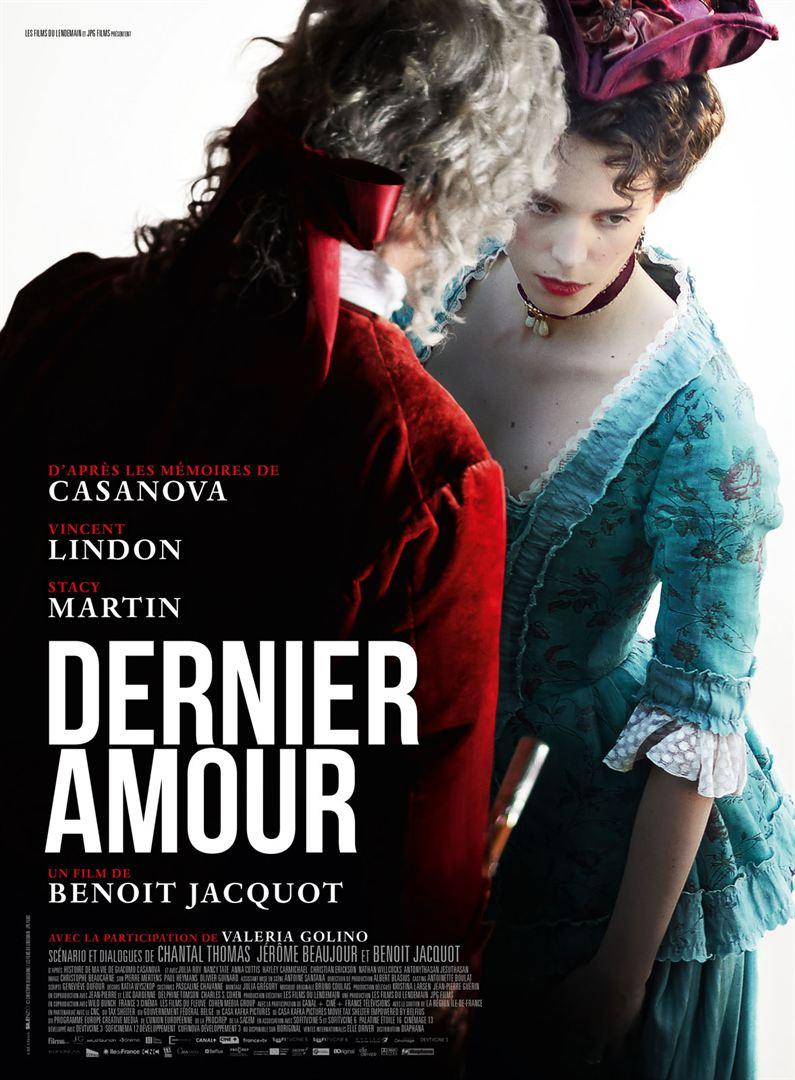
In the eighteenth century, Casanova, known for his taste for fun and play, arrived in London after having to go into exile. In this city of which he knows nothing, he meets several times a young courtesan, the Charpillon, which attracts him to the point of forgetting the other women. Casanova is ready to do anything to achieve her ends, but La Charpillon always escapes under the most diverse pretexts. She challenges him, she wants him to love her as much as he wants.
ٹریلر
کاسٹ
Benoît Jacquot
Director
Vincent Lindon
Casanova
Stacy Martin
Marianne de Charpillon
Valeria Golino
La Cornelys
Julia Roy
Cécile
Nancy Tate
Hortense Stavenson
Anna Cottis
La mère de la Charpillon
Hayley Carmichael
Anna
Christian Erickson
Lord Pembroke
Nathan Willcocks
Claremont
Jesuthasan Antonythasan
Jarba
Jean-Chrétien Sibertin-Blanc
Ambassadeur de France
Lionel Robert
M. de Castelbajac
Wolfgang Pissors
Domestique château de Dux
Catherine Bailey
Soeur de Lady Hortense
David Tudor-Glover
Mari de la soeur de Lady Hortense
Alan Fairbairn
Homme bal La Cornelys
Romain Valembois
Homme bal La Cornelys
Lucienne Deschamps
Femme bal La Cornelys
Jérôme Beaujour
Writer
Giacomo Casanova
Writer
Benoît Jacquot
Writer
Chantal Thomas
Writer
MovieBox سے آگے بھی entertainment picks
ہم casual games اور short drama پسند کرنے والوں کے لیے partner destinations بھی دکھاتے ہیں۔ کسی بھی تجربے کو ایک ٹیپ میں کھولیں۔
آپ کو یہ بھی پسند آ سکتا ہے
Casanova, Last Love
Signal in catalog
The Taste of Things
Signal in catalog
Serena
Signal in catalog
Frantz
Signal in catalog
Fated Hearts
Signal in catalog
Glory
Signal in catalog
Melody of Golden Age
Signal in catalog
The Princess Weiyoung
Signal in catalog
Sistas
Signal in catalog
Teen Wolf
Signal in catalog
Zatima
Signal in catalog
Snowfall
Signal in catalog
Jang Ok-jung, Living by Love
Signal in catalog
Fall in Love
Signal in catalog
Bossam: Steal the Fate
Signal in catalog
Heeramandi: The Diamond Bazaar
Signal in catalog
Goddess of Fire
Signal in catalog
The White Queen
Signal in catalog
The Scandal
Signal in catalog
The Rise of Phoenixes
Signal in catalog
Royal Nirvana
Signal in catalog
The Glamorous Imperial Concubine
Signal in catalog
My Cherie Amour
Signal in catalog
A dream like the true love
Signal in catalog
تبصرے
6 تبصرے
No, I´m not an expert on Casanova. Therefore I did some research after watching this movie. One episode stood out from his life if you ask me. He had a child with his own daughter. I thought that Casanova only had affairs outside his family. I don´t understand or approve of that decision. But all in all I guess that Casanova, above all, was most famous for his love affairs with many different women. And most love affairs have a great amount of romance, passion, seduction and flirtiness. But "Dernier amour"/"Casanova, Last Love" has too little of those feelings in my opinion. I understand that older people usually don´t have the same energy as younger people. But love affairs can contain many different things, not just bedroom stuff. I didn´t regret watching this movie. It has beautiful costumes and some tender moments. But I don´t know if I would want to watch this movie again.
A vision let's say very personal and original of Casanova: weakly charismatic, almost inexpressive, idle, depressed and even suicidal, ... I guess the film evokes a namesake, because even Jean-Claude Dus within Les bronzés font du ski (1979) is definitely more seductive. Except this pathetic and inappropriate non-sense, the costumes and sets are top.
Casanova, "the most powerful man in the world," the adorable phallus, in his mid-years, infatuated with a young woman half his age who doesn't give him enough attention. Isn't this the classical tragedy during all human existence, say from the Bible's King David to the numbers of fifty-year-old divorces nowadays? The sexual power young women have, even the ugliest or less talented one, drives crazy so many men and makes them put in risk their reputation, money, even their own life. Casanova here insists it is more than mere infatuation, and he is correct, his situation is far more complicated than that. What is the truth of his desire then? Is it about some power this particular woman intrinsically has? The movie rightly shows her ambiguously; she is attractive, yes, but also vulgar and manipulative. Therefore, is it something unsatisfying that he sees in himself? Maybe yes. Casanova is a libertine who has built a reputation as a womanizer; he has money, social influences, ex-lovers are fond of him. However, we see him here precisely on the verge of self-humiliation and degradation, risking losing everything just for the sake of receiving care and attention from a love that is impossible only for him. Casanova, "the most powerful man in the world," is the only one who cannot have this woman. This puzzle may be the punishment he unconsciously inflicts on himself, following the legend of Don Giovanni, the quest for moral redemption through self-inflicted spiritual and sexual pain. This movie is a masterpiece, for it shows the moment of realization that all human beings have, at some point, seeing the finitude of their lives. The film is also profoundly humanistic. It shows how and why power relations are complicated and bi-directional, far from what the current MeToo wave of childish self-victimization has popularized in the Anglo-American culture. Script and direction are precise and dynamic here, and the photography is evocative and technically perfect. Actors Lindon and Martin deliver enjoyable parts; they succeed at making this power game vivid and tragic.