
Title Matrix
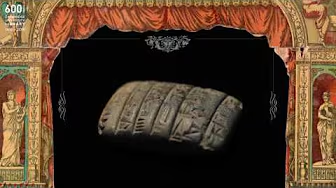
Curious Objects - 600 years of Cambridge University Library
MovieBox سے آگے بھی entertainment picks
ہم casual games اور short drama پسند کرنے والوں کے لیے partner destinations بھی دکھاتے ہیں۔ کسی بھی تجربے کو ایک ٹیپ میں کھولیں۔
آپ کو یہ بھی پسند آ سکتا ہے
Kids Songs by CoComelon
Signal in catalog
Alphabet (ABC) Songs by CoComelon
Signal in catalog
Primary 1 Science & Technology
Signal in catalog
Learn Colors with CoComelon!
Signal in catalog
Animation & Kids Songs collections For Babies | BabyBus
Signal in catalog
CoComelon & Friends Holiday and Christmas Videos for Kids | Little Baby Bum | Go Buster and More!
Signal in catalog
Year1 English
Signal in catalog
Let's learn about.... English Vocabulary for Kids
Signal in catalog
Level 1 English | Little Fox
Signal in catalog
BEST SONGS for TODDLERS 👶🎵 (1 to 3 year olds)
Signal in catalog
Primary 5 Mathematics
Signal in catalog
BEST of CoComelon Bath Song + Wheels on the Bus
Signal in catalog
Shapes, Colors, & Music by CoComelon
Signal in catalog
Masha & the Bear
Signal in catalog
JS 1 English
Signal in catalog
Family Fun by CoComelon
Signal in catalog
SS 1 Literature
Signal in catalog
JJ & Friends by CoComelon
Signal in catalog
Classic Fairy Tales: Season 1
Signal in catalog
Test Your English with TV Series and Movies
Signal in catalog
BabyBus | Baby Shark | Shark Songs for Kids | Shark Story
Signal in catalog
ABC Jamboree by StoryBots
Signal in catalog
Hank's Big Adventure!
Signal in catalog
Careers in business, marketing and finance
Signal in catalog
تبصرے
10 تبصرے
Why does one of the world's great research libraries have ectoplasm, a spirit trumpet and beard hair posted to Charles Darwin? The answers lie within 'Curious Objects' which opens to the public in Cambridge and online from November 3, 2016. Remember to subscribe to our channel as we celebrate 600 years of Curious Objects at Cambridge University Library.
Billions of words, millions of books, 600 years of Curious Objects. Cambridge University Library is celebrating its 600th anniversary with an exhibition of the weird and wonderful objects in its collections. This rather curious object comes from 18th century England and features a splendid rendering of the man who brought us Hamlet, Macbeth …and invented the word puke! Yes, it’s the Bard himself, William Shakespeare. Tobacco stoppers such as this were common and were used for stuffing down tobacco in a pipe. Where it came from is a mystery…we have no idea. Stick that in your pipe and smoke it!
Why does one of the world's great research libraries have ectoplasm, a spirit trumpet and beard hair posted to Charles Darwin? The answers lie within 'Curious Objects' at Cambridge University Library, which runs until March 2017 and is open free to the public. This Curious Object broadcasts voices from the beyond using the medium of…mediums. Apparently, the ‘Two Worlds’ spirit trumpet would float around the room emitting unearthly voices and exuding ectoplasm. It was made in the 1920s and is part of the archive of the Society for Psychical Research. We’re classifying this Curious Object under the heading of séance fiction. For more information about Curious Objects, click here:
“These Curious Objects are Ganjifa - playing cards and card games from India, Iran and the Arab world, and are thought to date from the early 18th century. Made of tortoiseshell and finely decorated, they must have belonged to someone absolutely minted. Introduced into India by the Mughals, the game of chance played with these cards was popular from the 16th to the 18th century. Play your cards right and we'll have another Curious Object for you next week.” Why does one of the world's great research libraries have ectoplasm, a spirit trumpet and beard hair posted to Charles Darwin? The answers lie within 'Curious Objects' at Cambridge University Library, which runs until March 2017 and is open free to the public. For more information about Curious Objects, visit:
Why does one of the world's great research libraries have ectoplasm, a spirit trumpet and beard hair posted to Charles Darwin? The answers lie within 'Curious Objects' at Cambridge University Library, which runs until March 2017 and is open free to the public. For more information about Curious Objects, click here:
This Curious Object tells the story of a rather hairy encounter between Charles Darwin and a man called Dr Frank Chance. Dr Chance attempted to counter Darwin's claim in Descent of Man that beard hair is always lighter than hair on the head – and went as far as sharing some of his own shearings with the great man himself. Frank’s beard and scalp hair clearly grew on Darwin – he mentioned his observations in the second edition. Darwin was happy for his readers to question his work, even by this strange means.
These Curious Objects are Asante gold weights and come from 19th or 20th century Ghana. They were made of brass, but we're used to measure gold dust which was the universal currency in West Africa at the time. Weights often featured animals, fish, weapons and tools – or human figures as demonstrated here. Their significance as an art form transcends their function and reflects wider Asante spiritual beliefs and cultural practises. According to a famous Asante proverb "When a fool is squandering his gold dust, he says his scales are out of order"
All the world’s a stage! But in the case of this Curious Object, the world is a tiny pocket globe covered in sharkskin and lined with a celestial chart. Measuring just 7cm in diameter, this globe was made in London around 1775. Pocket globes were first produced in England by Joseph Moxon and remained in vogue as a gentleman’s toy well into the 19th century. Often – as is the case here – they showed the latest terrestrial and celestial discoveries. This globe tracks the first voyage of Captain Cook’s Endeavour and reflects the discoveries he made. It was presented to the Royal Colonial Institute (now the Royal Commonwealth Society) in 1953 by Olive M Thompson. To borrow another line from Shakespeare: ‘That ends this strange, eventful history.’
Greetings, Comrades! This Curious Object is a Soviet lapel pin celebrating one of the most symbolic technological achievements of the 20th century. After decades of intense rivalry between the Soviet Union and the United States for Space Age supremacy, the two superpowers arranged a meeting – in space! – of the Soviet Soyuz spacecraft and the US Apollo. This badge from 1975 shows the Soviet and US flags above their respective spacecraft and was collected by the late Dr Catherine Cooke, who gathered a remarkable collection of Soviet paraphernalia including badges, cigarette boxes, propaganda posters and ration coupons. Until next time, Dosvedanya.
This curious object is the oldest man-made object in the library and comes from pre-dynastic Egypt, sometime between 3900 and 3650 BCE.