
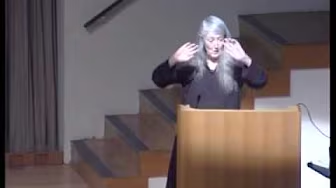
The Darwin College Lectures take place on Fridays during Lent term (January to March). The lectures are given at 5.30 p.m. in The Lady Mitchell Hall, Sidgwick Avenue, with an adjacent overflow theatre with live TV coverage. Each lecture is typically attended by 600 people so you must arrive early to ensure a place.
Pilihan hiburan di luar MovieBox
Kami juga menampilkan partner untuk penggemar game kasual dan short drama. Buka salah satunya hanya dengan satu ketukan.
Mungkin Anda Juga Suka
Kids Songs by CoComelon
Signal in catalog
Primary 1 English
Signal in catalog
Alphabet (ABC) Songs by CoComelon
Signal in catalog
BabyBus | Kids Favorite Nursery Rhymes | Kids Songs
Signal in catalog
Counting & Numbers Songs by CoComelon
Signal in catalog
Kids Songs & Nursery Rhymes | CoComelon, Blippi & Little Angel
Signal in catalog
HTML and CSS in depth
Signal in catalog
CoComelon | Netflix Jr
Signal in catalog
CoComelon Lane | Netflix Jr
Signal in catalog
March 2024 KIDS Songs from LooLoo Kids
Signal in catalog
GCSE English Language
Signal in catalog
CoComelon
Signal in catalog
CocoMelon | Little Baby Bum | Blippi - Nursery Rhymes & Kids TV Shows
Signal in catalog
CoComelon - Happy Holidays
Signal in catalog
Learn English With Disney Movies
Signal in catalog
Educational Videos for Children - Lingokids
Signal in catalog
CoComelon For Journeys
Signal in catalog
ABC Songs for Kids - CoComelon Nursery Rhymes
Signal in catalog
CoComelon Dance Party | Dance Along & Kids Songs
Signal in catalog
English lessons for kids - My English teacher
Signal in catalog
Nursery Rhymes by CoComelon
Signal in catalog
CoComelon Dance Party - Mix
Signal in catalog
English Fairy Tales @EnglishFairyTales
Signal in catalog
Primary 1 Science & Technology
Signal in catalog
Komentar
6 Komentar
Darwin College Lecture Series 2010. "Risk and Natural Catastrophes" by Professor Mark Bailey( Armagh Observatory) Natural catastrophes rare, high-consequence events present us with a unique conjunction of problems so far as risk is concerned. First, they can have an extremely long recurrence interval, so long that the greatest may not have occurred within living human memory. Secondly, the effects of events with which we are all too familiar, for example earthquakes, floods, volcanoes and storms, are easily trumped by the impacts of objects comets and asteroids that reach Earth from outer space; and thirdly, the largest of these events have a global reach, in principle threatening not just our civilisation but perhaps life on Earth itself. However, recognising that such events occur very rarely, should we make hay while the sun shines and ignore, ostrich-like, the significant actuarial risk; or should we seek to understand the phenomena and develop strategies to mitigate the threat and
Part of the Darwin College Lecture Series 2010. Social scientists tell us we now live that we live in a world risk society. But what does this really mean and what, if anything, do environmental risks, health risks, and natural disasters have in common with those posed by terrorism? When we move from the natural world to human threats are we still dealing with hard science or are we in the realm of speculation? Are the presumptions behind risk based counter-terrorism policies and the profiling of terrorist suspects safe? Terrorist acts are exceptionally rare but they pose the risk of catastrophic harm. No surprise then that we consent to intrusive measures that erode civil liberties in the name of avoiding such harms. The conceit of balancing liberty and security assumes that by degrading liberty we can reduce risk. In place of balancing might we do better to ask what really is at risk in the war on terror? We think of the risks posed by terrorism primarily in terms of subjective insec
Lecture given by Professor David Spiegelhalter in the 2010 Darwin College Lecture Series on the topic of Risk. There has been a traditional division between risk, which can be quantified using probability distributions, and uncertainty, which is the surrounding mess of doubt, disagreement and ignorance. In well-understood situations we may be happy to quote reasonable odds for future events, and I shall look at ways in which these risks can be communicated visually. When the problem is more complex, analysts may use a mixture of judgement and historical data to construct a mathematical model that can assess future risks, but deeper uncertainties may be glossed over. I will use examples from swine flu to climate change to illustrate different approaches to dealing with uncertainty, from ignoring it to trying to fully quantify it, and conclude that we should all try to be aware and open about the magnitude and potential consequences of our ignorance.
Lecture presented by Professor John O'Doherty for the Darwin College Lecture Series 2010. A deeper understanding of how the brain makes decisions will not only inspire new theories of decision making, it will also contribute to the development of genuine artificial intelligence, and it will enable us to understand why some humans are better than others at making decisions, why humans with certain psychiatric and neurological disorders are less capable of doing so, and why under some circumstances humans systematically fail to make rational decisions. Most decisions made in everyday life are taken for the purposes of increasing our well-being, whether it is deciding what item to choose off a restaurant menu, or deliberating over what career path to follow. Prominent amongst these is the value or utility of each decision option, which indicates how advantageous a particular option is likely to be for our future well-being. Another relevant signal present in the brain is the riskiness att
Darwin College Lecture Series 2010 by Professor Christopher Hood, University of Oxford
Darwin College Lecture Series 2010. "Risk and Humanities". Professor Mary Beard (Cambridge). Was there risk before modernity? This lecture explores how we might tell the ancient history of risk—from oracles (an ancient form of risk assessment) through gambling and agricultural strategies to the parade of Luck and Chance in sculptural form. In Greece and Rome (and other pre modern societies) is it misleading to think in terms of risk? Is it more helpful to ask simply, What did people worry about?—a question to which we find some surprising answers. At the same time, there is another agenda underlying this lecture: an exploration of the risks facing research and teaching in the Humanities. What do academics need to be worried about today and for the future? The lecture will include the first consultation of the Oracles of Astrampsychus for many centuries. Biography Mary Beard is one of Britains best-known Classicists Fellow of Newnham College and a distinguished Professor of Classics at