
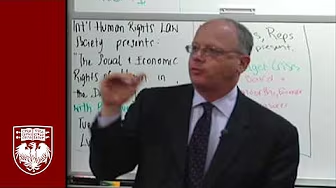
An annual series of lectures originally created in honor of the Law School's Centennial in 2002-03. Three lectures (with free lunch, of course) are given each quarter by our faculty on topics related to the intellectual life and history of the Law School.
Entertainment picks beyond MovieBox
We also spotlight partner destinations for casual games and short-drama fans. Open either experience in one tap.
You Might Also Like
SEAS Videos
Signal in catalog
Complete Maths - Mindmap Revision For JEE 2023
Signal in catalog
Complete Class 11 + JEE CHEMISTRY - JEE Mind Map
Signal in catalog
Yoga Time with VOLT
Signal in catalog
5 EASIEST Ways to Make Money With AI (No One is Doing This)
Signal in catalog
Special Videos
Signal in catalog
1° Secundaria Curso de Regularización
Signal in catalog
Complete ORGANIC CHEMISTRY for IIT-JEE Advanced 2025 | KATTAR JEE ADVANCED Series 🔥
Signal in catalog
Excel Basics for Data Analysis
Signal in catalog
Phonics Fun with VOLT
Signal in catalog
Science Trek
Signal in catalog
Complete Physics One Shot for JEE Main 2023 | Manzil Legends
Signal in catalog
Kids Songs & Nursery Rhymes | CoComelon, Blippi & Little Angel
Signal in catalog
Top of the Blocks
Signal in catalog
Learn To Read with Ms Rachel
Signal in catalog
Aulas de História para o 8º ano
Signal in catalog
Bebefinn Best Kids Songs and Nursery Rhymes 🎵
Signal in catalog
IELTS Listening and Speaking Sections Skills Mastery
Signal in catalog
ABC Songs for Kids - CoComelon Nursery Rhymes
Signal in catalog
Data Science Methodology
Signal in catalog
Social Studies Videos for Kids
Signal in catalog
English Advanced C1
Signal in catalog
SEAS Graduate Students
Signal in catalog
Reggae
Signal in catalog
Comments
10 Comments
Why have we taken so few precautions in the face of threatening climate change? In a February Chicago's Best Ideas talk entitled "Climate Change and the Battle of the Generations" Dean Saul Levmore focused on the difficulty of dealing with a long-off threat in our political system.The question, he says, is how voters and their politicians can be encouraged to care about problems that can be deferred for consideration by a different electorate or set of taxpayers – but at much higher cost. We know that we should solve most long term problems sooner rather than later, but there are pressures that put off painful solutions. Dean Levmore draws on what we know about “median voters” and median citizens in order to hazard guesses about the coming battle among generations. In this “battle,” young voters will grow increasingly concerned about what is likely to occur as they age – but these voters do not yet have sufficient political power. In turn, arrangements among countries will be seen to d
Alison LaCroix, Professor of Law at the University of Chicago Law School, discusses her current research on the history of Congress’ spending power and how it relates to current debates. ➡ Subscribe: About #UChicago: Since its founding in 1890, the University of Chicago has been a destination for rigorous inquiry and field-defining research.This transformative academic experience empowers students and scholarsto challenge conventional thinking in pursuit of original ideas. #UChicago on the Web: Home: News: Facebook: Twitter: Instagram: University of Chicago on YouTube: /uchicago *** ACCESSIBILITY: If you experience any technical difficulties with this video or would like to make an accessibility-related request, please email digicomm@uchicago.edu.
Mary Anne Case, professor of Law at the University of Chicago Law School, puts her work on reproductive technologies and on analogies in the governing of marriage and business corporations in an explicitly Coasian context. She analyzes the long history and recent past to make predictions about the future of families, sex, and society. We are now generally free, as Coase observes, to structure our business affairs in corporate or partnership form, as a franchise operation, or as a sole proprietorship. Both law and society now offer a variety of ways to structure one's personal life: the provision of sex and care, and the production of children can each now be outsourced or internalized within a legally recognized family structure. May 1, 2012 ➡ Subscribe: About #UChicago: Since its founding in 1890, the University of Chicago has been a destination for rigorous inquiry and field-defining research. This transformative academic experience empowers students and scholars to challenge convent
Martha Nussbaum, professor of Law and Ethics at the University of Chicago's Philosophy Department, Law School, and Divinity School, discusses her ideas in teaching a type of patriotism in schools that is rooted in good values, protective of conscience, and friendly to critical thinking and dissent. She supports her argument from the history of the U.S. and India and from figures such as Lincoln, King, Gandhi, and Nehru. This event was sponsored by Winston & Strawn LLP. For more information on this event, visit April 10, 2012 ➡ Subscribe: About #UChicago: Since its founding in 1890, the University of Chicago has been a destination for rigorous inquiry and field-defining research. This transformative academic experience empowers students and scholars to challenge conventional thinking in pursuit of original ideas. #UChicago on the Web: Home: News: Facebook: Twitter: Instagram: University of Chicago on YouTube: /uchicago *** ACCESSIBILITY: If you experience any technical difficulties with
Omri Ben-Shahar, Professor of Law at the University of Chicago Law School and Kearney Director of the University of Chicago Institute for Law and Economics, discusses the place of "No Contract" assurances in the broader context of consumer protection and his ongoing work on the failings and promises of consumer law. "No Contract" is a popular type of consumer transaction through which businesses lure consumers with the "no contract" assurance—a promise that the consumer can walk away any time, without any commitment. This scheme is increasingly common in cable and phone services, health clubs, security services, and other transactions that used to require minimum duration. Ben-Shahar answers the questions: What is a "No Contract" contract? What does the misnomer "No Contract" intend to signal to consumers? What effects does the "No Contract" arrangement have on other elements of the transaction? What do consumers have to give up in order to enjoy the "No Contract" guarantee? Is it over
Anup Malani, professor at the University of Chicago Law School, describes a number of surprising contract provisions that can be used to tackle the holdup problem, where a buyer and seller agree on a price for a future date, but the seller later demands a higher price. He also discusses how contract law can affect the scope and ownership of firms. In 1937, Ronald Coase asked: if markets are so efficient at allocating resources, why are so many resources allocated within firms? His answer was that market allocation entailed transactions costs and, when these were very high, transactions will take place within firms. Oliver Hart, with Sanford Grossman and John Moore, suggested the holdup problem could be overcome if the buyer owns a key asset of the seller or the seller's whole firm, which can prevent the seller from holding up the buyer. Hart, Grossman, and Moore transformed Coase's theory of how large firms were into a theory of who owns firms. Since then, there have been numerous effo
Aziz Huq, assistant professor of law at the University of Chicago Law School, discusses what forum should be employed to adjudicate the status of terrorist suspects. Recent clashes between Congress and the President have yielded highly controversial provisions in a recent National Defense Authorization Act that might force such adjudications into a military forum. The problem of forum choice is typically framed as a simple matter of law, but this assumes doctrinal rules can easily sort suspects between civilian and military venues. However, the choice of forum question can better be understood as a problem of institutional design. Huq also discusses the key institutional design decision that is jurisdictional redundancy, which is currently pervasive but is prone to abuse and needlessly costly. Aziz Huq has clerked for Judge Robert D. Sack of the U.S. Court of Appeals for the Second Circuit and Justice Ruth Bader Ginsburg of the Supreme Court. He has worked as Associate Counsel and Dire
As we near the end of the first term of our nation's first African American President, does race still matter? How have our perceptions of race changed? Craig Futterman will share observations and experiences arising from his and his students' engagement working on issues of police accountability from the ground floor of a family high rise in a Chicago public housing community that made up eight square blocks of Chicago's South Side. Prof. Futterman argues that engaging this "view from the ground" is necessary to inform our policies and conversations around fundamental issues of race and class in America and to move us toward a more just society. ➡ Subscribe: About #UChicago: Since its founding in 1890, the University of Chicago has been a destination for rigorous inquiry and field-defining research. This transformative academic experience empowers students and scholars to challenge conventional thinking in pursuit of original ideas. #UChicago on the Web: Home: News: Facebook: Twitter:
Ponzi schemes come in many sizes. The colossal fraud engineered by Bernard Madoff is an occasion to rethink the legal rules and remedies associated with such episodes. But then there are smaller Ponzi-like schemes, such as fraud in law school admissions, and the question of whether law does or should play any role. At the other extreme are nation-size Ponzi schemes, such as our recent mortgage-and-foreclosure crisis and, similarly perhaps, long-range deficit spending in many countries, such that one generation defrauds another. In this CBI, Professor Saul Levmore asks why law might be much better at one of these levels than at the others. Concrete problems can help us understand law's comfort zone, or its proper domain. ➡ Subscribe: About #UChicago: Since its founding in 1890, the University of Chicago has been a destination for rigorous inquiry and field-defining research. This transformative academic experience empowers students and scholars to challenge conventional thinking in purs
This lecture will draw from Professor Hartog's forthcoming book, Someday All This Will Be Yours: A History of Inheritance and Old Age. It uses transcripts from a series of late nineteenth and early twentieth century New Jersey cases to explore the problem of who should be paid for household work and for intimate caretaking. The transcripts reveal both intimate details of family life and some of the political and ethical dilemmas that attended to the situations of adult children in a mobile and free society. ➡ Subscribe: About #UChicago: Since its founding in 1890, the University of Chicago has been a destination for rigorous inquiry and field-defining research. This transformative academic experience empowers students and scholars to challenge conventional thinking in pursuit of original ideas. #UChicago on the Web: Home: News: Facebook: Twitter: Instagram: University of Chicago on YouTube: /uchicago *** ACCESSIBILITY: If you experience any technical difficulties with this video or wou