
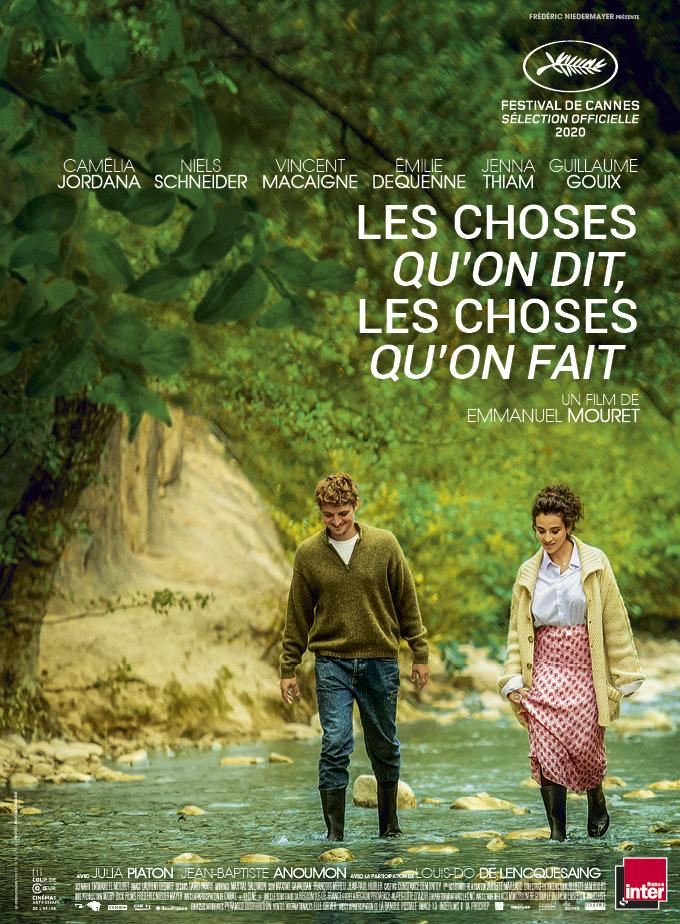
Waiting for her boyfriend to join her on a country vacation, three months pregnant Daphne bonds with his cousin Maxime, and their shared intimacy brings them closer together into a full fledged love affair.
الإعلان الترويجي
طاقم العمل
Emmanuel Mouret
Director
Camélia Jordana
Daphné
Niels Schneider
Maxime
Vincent Macaigne
François
Émilie Dequenne
Louise
Jenna Thiam
Sandra
Guillaume Gouix
Gaspard
Julia Piaton
Victoire
Jean-Baptiste Anoumon
Stéphane
Louis-Do de Lencquesaing
Le réalisateur
Lise Lomi
Claire
Sarah Capony
Bianca
Fanny Gatibelza
La femme de Stéphane
Milla Savarese
Léa
Catherine Lecoq
La marchande de vin
Sacha Requiem
L'ami de Claire
Claude Pommereau
Le philosophe
Emmanuel Mouret
Writer
خيارات ترفيهية إضافية خارج MovieBox
نبرز أيضًا وجهات شريكة لعشاق الألعاب الخفيفة والدراما القصيرة. افتح أي تجربة بضغطة واحدة.
قد يعجبك أيضًا
Love Affair(s)
Signal in catalog
Diary of a Fleeting Affair
Signal in catalog
It Boy
Signal in catalog
One Wild Moment
Signal in catalog
السلطة اليونانية
Signal in catalog
Sistas
Signal in catalog
Zatima
Signal in catalog
الجنس والحياة
Signal in catalog
إميلي في باريس
Signal in catalog
Perfect Crown
Signal in catalog
أيام الزهور
Signal in catalog
الورثة
Signal in catalog
خلية الحب
Signal in catalog
Secret Lover
Signal in catalog
Perfect10 Liners
Signal in catalog
My Bias, My Boss
Signal in catalog
حبي لك بضاعة لا تنفد
Signal in catalog
ضد رغبة الجميع
Signal in catalog
اسأل النجوم
Signal in catalog
Not Suitable for Work
Signal in catalog
Á La Carte
Signal in catalog
القيمة المطلقة للحب
Signal in catalog
We Are
Signal in catalog
Begin Again
Signal in catalog
التعليقات
10 تعليق
Summary Over two hours, Emmanuel Mouret (director and screenwriter) unfolds this admirable human comedy (in the Balzacian sense) of intertwined stories, with the motives of his characters centered on desire and love and the delicate balance between what They tell each other, what they do, what they feel, what they show (us), the tacit or explicit agreements and the imponderable. And he does it using different tones and genres and supported by extraordinary performances. Review: Maxime goes to a country house to spend a few days with his cousin Francois and Daphné, his partner. But Francois had to leave before his arrival and Maxime and Daphné will spend a few days alone chatting and revealing their respective sentimental stories. Emmanuel Mouret (director and guinosta) achieves an admirable mosaic of intertwined stories. In the first place, there are two main stories, with their respective points of view: Daphné's and Maxime's, each developed with a different tone, with some voice-over introducing or commenting on the flashbacks that alternate. On the other hand, there is the present time, where the point of view is that of the spectator. Then other moments with other points of view will be added. The inventory of situations is overwhelming, exposed without haste and without pause, with flirtations, friendships, courtships, couples, marriages and infidelities, always highlighting the difference between "what is said and what is done", to what I I would add "what it feels like." And yes: it is a French film with a literary imprint where the characters talk a lot about what happens to them, but where they are also silent as much. The style of the story refers to various cinematographies, depending on which story and characters it is and at what point in the story we find ourselves: at times it seems like a Rohmer film and at others a very subtle humor close to Woody Allen appears, for example. Different tones of comedy (tangled, romantic, sentimental), melodrama and drama are combined, with extraordinary use of a soundtrack with classical music ranging from Purcell and Haydn to Poulenc. In this way, the sequence of scenes could also be assimilated to a series of recitatives and arias from a Mozart opera. But beyond the references and influences, the result is absolutely personal. Far from causing dispersion, the script solidly interweaves the stories, sheds new light in their recesses and the dramatic crescendo is incessant, reaching an extremely emotional climax. Within a solid cast, Niels Schneider stands out as Maxime, a timid aspiring writer (in the antipodes of the manipulative Philippe who played in An Impossible Love or the Object of Desire in Dolan's Imaginary Loves), Camélia Jordana who brings all her expressiveness to Daphné, a film editor, Vincent Macaigne as the endearing Francois, Daphne's partner and Émilie Dequenne's Louise, with all her surprising edges. In sum, over the course of two hours, Mouret unfolds this remarkable human comedy in the Balzacian sense, with the motives of his characters centered on desire and love and the delicate balance between what they say to each other, what they do, what they feel, what (to us and is) shown and hidden, seduction games, tacit or explicit agreements, renunciations, confusion, the imponderable.
Would have quite agree with the other reviewer (teokaranikas) until it came to the ending. Daphne so very clearly does not love Francois, she's only with him out of convenience and then because she's pregnant. Her and Maxim really fall in love, while Francois still has feelings for his wife. At the train station for a brief moment it looked like Daphne finally had the guts to run away with Maxim, but no - she came back off the train. I was already screaming NO when we got to teh final scene seveeral months later. Daphne, now heavily pregnant, sees Maxim and seems full of joy & hope. I thought "Whatever you do, don't pull that old cliché of her then seeing him to be with another woman". But of course they do exactly that. They show him with the equally pregnant Victoria, a woman from his past. We and Daphne know that it's not his child, Victoria had left her husband despite being pregnant. For a brief moment I was still hopeful that Daphne had left Francois, but, again, no - he was right there. Why on earth have the 2 main characters be so passive and stay/get together with people they don't really want to be with?????? I was literally screaming at the screen. It also re-inforces that other cliché in romantic films that a pregnant woman can't really change her mind and walk out of their partners. Ok, Victoria did, but she's just a very minor character who literally only appears in 4 scenes. At least leave the ending open if you must - but not this!! One might argue that the ending reflects the title. But it doesn't. Daphne & Maxim never talk about loving each other, it's expressed in their action. when together. There is no contrast between what's said and what's done. I really don't get it...
Profoundly French, so well written, it's almost poetic. A bunch of love stories intertwined and with philosophical overtones, mixing emotions, intrigue, romantic interludes, ethical conduct, and a good latitude of human dynamics. A must see.
After 10 minutes of this film I was on the verge of walking out and muttering to myself that it was like a very bad Eric Rohmer film; but the longer it went, the more I became engrossed. It's definitely like an Eric Rohmer film in the emphasis almost entirely on dialogue and the concentration on the loves and relationships within people's lives. A very superior Eric Rohmer film, with the screenplay developing the characters and engaging our sympathies very strongly. I didn't know the director or any of the actors, but I'll be looking out for them in the future. Also the cinematographer: what a joy it was to watch a French film shot with fixed cameras instead of the hand-held cameras with which French cinema seems to be obsessed. It's certainly not a film for everyone; but for those who don't mind a talky film and have the patience and concentration to follow the twists and turns of the plot, it's a gem.
Saw this film as part of a local film festival and unfortunately found it a huge disappoinment. It starts out strong with interesting characters entangled in desire/love however once the flashback stories are finished the Daphne / Maxime storyline takes center stage and does not feel well deserved at all. I don't feel the lessons in this movie are as profound as the movie tries to be. I enjoyed the scenery and general camera work presented throughout the film. After finishing the movie the only character arc I have respect for is Louise's.
A true masterpiece! The script, the dialogs, the acting, the messages, the divine music, classic mostly, that ran during the whole movie in the best way possible. At last a great French movie.
Help! Pathos celebrated by pedantic and disembodied dialogues of nickname delicate characters, in the service of a pretentious script believing to know everything about love and human relationships. Pseudo intellectual navelist filmed theater. with each word I have the impression of reading the script so much all lack of naturalness and emotion and emptiness perspires. I appreciate the actors but hardly to get into them as their dialogues are articulated like a poetry which one must recite like a music without emotions. Obviously the press and the profession acclaim and cry genius, which ends up annoying me. Nothingness dictated with rhymes, that's not enough to make up the boredom ... What could be yet another reflection on love and passion is instead a long and far too long agony of the senses with a gallery of hollow characters, always nice and gentle even simplet, distant without depths preventing to be captivated by their coming and going, their silences and their destiny. When will the French cinema that I love and respect stop producing this kind of films?