
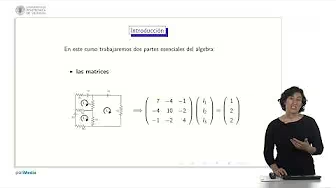
Este canal forma parte de un MOOC (curso abierto y masivo) que puedes encontrar en
Entertainment picks lampas sa MovieBox
May mga partner destination din kami para sa fans ng casual games at short drama. Buksan ang alinman sa isang tap lang.
Maaari Mo Ring Magustuhan
Campus Chronicles
Signal in catalog
Kids Songs by CoComelon
Signal in catalog
CoComelon
Signal in catalog
Alphabet (ABC) Songs by CoComelon
Signal in catalog
How to Be a Better Human
Signal in catalog
Numberblocks & Alphablocks - Learn to read and count #readingmonth
Signal in catalog
New Compilations | Chuggington
Signal in catalog
Berklee Holiday Videos
Signal in catalog
🎮⭐ Play & Watch | Trailers and Gameplays
Signal in catalog
Learn about Good Habits & Good Manners for Kids
Signal in catalog
Sleepytime! 💤 | Learn Words with Yakka Dee |BBC Kids
Signal in catalog
⏰🤣 Hours of Fun | Talking Tom Shorts Compilations
Signal in catalog
CoComelon #shorts
Signal in catalog
SS 3 Chemistry
Signal in catalog
Learn English with Movies
Signal in catalog
Primary 1 Science & Technology
Signal in catalog
Learn English With Disney Movies
Signal in catalog
Test Your English with TV Series and Movies
Signal in catalog
All New Akili & Me
Signal in catalog
Educational Cartoons for Kids | Learn with Sheriff Labrador
Signal in catalog
Happy Holidays from Netflix Jr!
Signal in catalog
Popular Compilations by CoComelon
Signal in catalog
Animal Fairy Tales: Season 3 (An ebook of 25 stories)
Signal in catalog
ABCs Learn the Alphabet
Signal in catalog
Mga Komento
10 Mga Komento
Título: Cramer's rule Descripción automática: In this video, the presenter explains how to use Cramer's rule to solve systems of linear equations. The video begins by reviewing the concepts of linear equation systems and determinants of square matrices. It establishes the key criteria that a system must have the same number of equations as unknowns for Cramer's rule to be applicable, and the matrix must be invertible, indicated by a non-zero determinant. The video then illustrates how to express a system of linear equations as a matrix equation, showing the coefficients of the system and the independent terms and how these can be used to form the coefficient matrix, the vector of unknowns, and the vector of independent terms. Moving on to the application of Cramer's rule, the presenter details that it involves solving for each unknown in the system by calculating the determinant of a modified matrix where a column of the coefficient matrix is replaced by the vector of independent terms
Título: Inverse matrix calculation Descripción automática: In this video, the presenter explains the process of calculating the inverse of a matrix using the method of adjoints. This method relies on understanding the determinant of a square matrix, which determines if an inverse exists (non-zero determinant) and its calculation. The instructor introduces the concept of a complementary submatrix, which is formed by excluding the row and column of a selected element within a matrix. This is used with the minor complementary, the determinant of the complementary submatrix, to define the adjoint of an element after applying the appropriate sign based on its position. The video goes on to describe how a matrix is considered invertible if its determinant is non-zero. To find its inverse, one divides 1 by the determinant and multiplies it by a matrix of the adjoints of the original matrix's elements. The lecturer walks through an example of this method using a specific matrix, highlighting t
Título: Matrix Range Descripción automática: In this video, the presenter explains the concept of the range (or rank) of a matrix and how to calculate it using determinants. The determinant is firstly described as a numerical value associated with a square matrix that indicates whether the matrix has an inverse and if it contains rows or columns that are linear combinations of others. To calculate the range of a matrix, one must identify the largest square submatrix with a non-zero determinant, known as a minor of the matrix. The speaker uses the notation "det(A)" to represent determinants and describes the process of calculating minors of various orders from a given matrix "B" with dimensions n by m. By selecting "r" rows and "r" columns from the matrix "B," minors of less than order "r" are determined. An example is given with a 2x3 matrix "B," demonstrating the inability to create a minor of order 3, and thus revealing that the rank of "B" is 2. Another example uses a larger matrix
Título: Determinants Descripción automática: In this video, an educational lesson on determinants of square matrices is presented. The concept of a determinant is introduced, explaining its importance for quickly determining if a matrix has an inverse or if its rows or columns are linear combinations of others. The lesson begins with the simplest case, the determinant of a 1x1 matrix, and then moves on to 2x2 matrices, demonstrating how to calculate the determinant by multiplying the diagonal elements and subtracting the products of the secondary diagonal. The video then expands the concept to 3x3 matrices, showcasing the calculation of determinants involving the addition and subtraction of products from both the main and secondary diagonals. An example is provided to illustrate the process, leading to a method known as Sarus' rule, which simplifies determinant calculations visually. Properties of determinants are explained, such as transposition, zero lines, swapping of parallel lines
Título: Matrix equations Descripción automática: In this video, the topic of matrix equations is introduced, explaining what they are and how to solve them. The instructor first defines a matrix equation and highlights that the dimensions of the matrices involved are crucial for the equations to be solvable. Two examples are used to illustrate the process, with emphasis on the importance of matrix size for the operations to be valid. Starting with the first example, the presenter shows how to isolate the variable matrix X using matrix subtraction and brings up the concept of inverse matrices for situations where division is not possible. The process includes ensuring that the inverse matrix exists by using the Gauss method, which confirms the invertibility of the matrix and allows for its isolation. The second example follows a similar process, emphasizing the importance of the equation itself in determining the size of the solution matrix. The Gauss method is once again employed to fi
Título: Regular matrices Descripción automática: In this video, the instructor explains the concept of regular square matrices and how to calculate their inverses. The presentation covers the definition of square matrices, matrix multiplication, and the Gauss method for solving linear equation systems. A regular square matrix is defined as one that can be multiplied by another matrix to produce the identity matrix, both pre- and post-multiplication, and this other matrix is called the inverse matrix, denoted as "A" raised to the power of minus one. The video outlines important properties of inverse matrices, including their uniqueness and the fact that if a matrix is regular, so is its product with another regular matrix, and vice versa. Additionally, the inverse of a product of matrices is related to the inverses of the individual matrices. The lecturer introduces two methods to calculate inverse matrices: solving a system of equations and using the Gauss method. The former involves e
Título: Operations with matrices Descripción automática: In this video, the presenter introduces the fundamental operations that can be performed with matrices: addition, multiplication by a scalar, and matrix multiplication. They begin by explaining that a matrix is an arrangement of numbers into rows and columns, denoted by a capital letter or a subscript notation to simplify the calculations in the operations. For addition, matrices must be the same order, meaning having the same number of rows and columns, and are added element by element. Addition of matrices has several properties such as being commutative, associative, having a matrix zero that doesn't change the result when added, and the existence of opposite matrices that lead to a zero matrix when added to the original. The multiplication of a matrix by a scalar involves multiplying each element of the matrix by a number. The presenter lists properties of scalar multiplication with matrices, which mirror those of real-number
Título: Definition of Matrix Descripción automática: In this video, the presenter introduces the concept of matrices and explains various classes of matrices. The explanation begins with the context of linear equation systems and demonstrates how these can be represented using a matrix, highlighting that matrices facilitate simpler calculations. Examples include representing the connections between airports in different countries as a matrix, where each entry indicates the number of flights between them. The video describes a matrix as a collection of numbers arranged in rows and columns, clarifying that the size is denoted by the number of rows (m) times the number of columns (n). Matrices are shown to come in various sizes, including square matrices, where rows and columns are equal, and vectors, which are matrices of size one row by n columns or m rows by one column. The concept of equality in matrices is introduced; two matrices are equal if they match term-to-term. The presenter t
Título: Examples of systems of linear equations with parameters using the Gauss method Descripción automática: In this video, the instructor explains the process of solving systems of linear equations using the Gauss method, particularly focusing on systems with unknown coefficients, or parameters. To illustrate the Gauss method, the instructor walks through an example of a linear system with known coefficients. The method involves converting the system into an augmented matrix, performing row operations to achieve upper triangular form, then rewriting the matrix as a system of equations to determine that it is consistent and indeterminate with infinite solutions. The video proceeds with examples where not all coefficients are known, requiring parameterization. The instructor shows how to apply the Gauss method to these systems, emphasizing the importance of not dividing or multiplying by zero. The solution process includes converting the system to an augmented matrix, carrying out row
Título: Gauss method Descripción automática: In this video, the instructor discusses the method for solving systems of linear equations. The method is explained as a means to simplify a given system to an equivalent one with the same solutions, enabling easier resolution. The method employs equivalence transformations to systematically eliminate variables and reduce the system to upper triangular form. The explanation begins with a basic understanding of what constitutes a linear equation system, how solutions might be determined or deemed non-existent based on the set of equations provided. The instructor then distinguishes between different types of systems: consistent and inconsistent, further identifying consistent systems as either determined (with a single solution) or indeterminate (with infinite solutions). Examples are provided to illustrate the process. The instructor first demonstrates the method on a simple system where variables can be isolated and substituted to find the