
Pilihan hiburan di luar MovieBox
Kami juga menampilkan partner untuk penggemar game kasual dan short drama. Buka salah satunya hanya dengan satu ketukan.
Mungkin Anda Juga Suka
Personal, social and emotional development
Signal in catalog
Hey Duggee
Signal in catalog
Numberblocks Season 7
Signal in catalog
Student Stories
Signal in catalog
SS 1 Biology
Signal in catalog
Nursery Rhymes & Kids Cartoon (All!!) | Kiki and Miumiu | Baby Shark | Fire Truck | Top Playlist - Nursery Rhymes & Kids Songs by BabyBus
Signal in catalog
Kids Songs & Cartoons of Kitten Family | Kids Cartoon for Kids | BabyBus
Signal in catalog
JS 1 Science & Technology
Signal in catalog
🏝️🗺️ Talking Hank’s Adventure Guide | Explore & Learn
Signal in catalog
Special Videos
Signal in catalog
Numberblocks Mission HQ!
Signal in catalog
Charlie and Lola - Season 1
Signal in catalog
Learn English With Disney Movies
Signal in catalog
Test Your English with TV Series and Movies
Signal in catalog
Educational Cartoons for Kids | Learn with Sheriff Labrador
Signal in catalog
Learn about Good Habits & Good Manners for Kids
Signal in catalog
BEST of CoComelon Bath Song + Wheels on the Bus
Signal in catalog
Bengali Kids Cartoon Videos
Signal in catalog
Numbers Songs by StoryBots
Signal in catalog
CoComelon | Netflix Jr
Signal in catalog
CoComelon #shorts
Signal in catalog
All New Akili & Me
Signal in catalog
Sheriff Labrador New Episodes
Signal in catalog
🎃🕯️🧛♀️ HALLOWEEN STORIES 2025 🕷️🧹👻
Signal in catalog
Komentar
9 Komentar
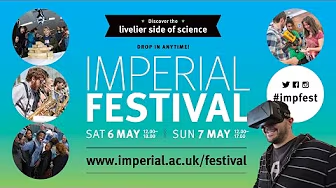
Professor Michele Dougherty After 20 years in space and over a dozen in orbit around the ‘jewel’ of our solar system, the Cassini spacecraft is entering the final chapter of its story. This extraordinary mission has discovered new moon’s, got up close like never before to the famous rings, and even uncovered evidence for organic materials and potential habitable places for life. Michele Dougherty leads on the magnetometer instrument on Cassini, which was used to discover plumes of water coming off the moon Enceladus. Before the craft finally dives into the gas giant to its death in September Michele will discuss its history of discoveries and the mysteries that could yet be revealed, such as what really lies beneath the cloud tops and how long is a day on Saturn?
Professor Paul Ramchandani Can the right type of early years parenting affect our relationships and even our risk of developing psychological problems later in life? And can this nurturing type of parenting be taught? Paul Ramchandani and his team are working to help parents learn how to respond to all sorts of signals and forms of communication given out by very young children. From smiles to simple eye contact these can be easily missed in maelstrom of life, but if noticed give clues to a child’s preferences and general happiness. During his talk Paul will look at some of the research behind these theories that will also explain where our understanding of our attachments as babies comes from.
Dr Tony Goldstone Recent studies have confirmed that targeting hormones that make us feel full after eating reduces appetite and food craving. Obesity expertTony Goldstonewill discuss the science behind the pleasure of eating and the possibility of designing drugs to help people with obesity to lose weight by interfering with these ‘reward’ mechanisms in the brain. They might also help people give up smoking, and drinking alcohol.
Professor David Miles Why are house prices in the UK so high and will the rate of recent rises continue into the future. Professor David Miles has been looking into to the past and around the world for answers
*We apologize for the audio problems at the start of this video. The audio returns to it's usual quality after approximately 30 seconds* Professor Zoltan Takats & Dr Daniel Leff Surgical removal of cancer is often the best hope for curative treatment. But it’s very challenging for surgeons to tell by sight and touchalonewhich tissues are cancerous and which are healthy. This means one in five breast cancer patients require a second operation to fully remove their tumour. The iKnife hasthe potential to change this. This pioneering technology can tell surgeons what tissues they are cuttingthrough in real time. Professor Zoltan Takats & Dr Daniel Leff, from the Cancer Research UK Imperial Centre, discuss the story of this innovative technology and the impact it could have for cancer patients in the future.
Marianna & Stephanie Kapsetaki International pianists, science PhD students and twin sisters Marianna and Stephanie Kapsetaki present 'Music of Life' - a multimedia experience made up of silent documentaries supported by a live classical piano performance that together highlight advances in evolutionary biology. In a world of Darwinian survival of the fittest, why do organisms cooperate? In evolution, only one thing counts: gene copies. Co-operators may have less offspring but, as a result of providing help to their family, they may leave many more nieces, nephews, or grandchildren. This is termed "kin selection". Kin selection and cooperation among non-relatives are important in the Major Evolutionary Transitions in individuality where previously independent units become capable of replicating only as part of a whole group. Cooperative behaviours lead to this complexity and prevent us from evolving back to the primordial soup. Welcome to the world of Major Evolutionary Transitions in
Professor Jonathan Haskel How often do we hear this complaint directed at our modern economy where regenerated factories that once produced cars, ships and steal are commonly filled with designers, marketing professionals and ideas people who make…well nothing. But is this a bad thing? And if so why? Jonathan Haskel has been investigating this revolutionary industrial shift for a new book “Capitalism without the Capital”. In a sneak preview he will explore the true impact of the emergence of our ideas economy - from prompting inequality, as wealth concentrates in firms with high profits but low numbers of workers, to underpinning our cultural demand for city living, where ideas people strive to live near and learn from others like them.
Professor Aaron Williamon How does music affect health and wellbeing? Can it be used to help people suffering from stress or those with particular conditions or disorders? Aaron Williamon, Daisy Fancourt and Katey Warran are from the Centre for Performance Science, a partnership between Imperial and the Royal College of Music, and they have been investigating the effects of making music on mental and physical health. Join them at Imperial Festival for an interactive singing session with the Sing with Us choir, a distinctive initiative run by Tenovus Cancer Care exploring whether singing affects mental health, wellbeing, quality of life and social support for people affected by cancer.
Professor Dario Farina Robotic technology can already reproduce missing human limbs for near complete dexterity and could in the not too distant future even surpass our own biological potential. However if we want to build a man-machine interface that truly creates a sense of natural control of movement we require not just further advances in robotics but also to probe deeper into our own nervous system. Professor Dario Farina will be showing off the latest advances in robotic limbs during his Festival talk, before discussing the obstacles to further progress, and imagining a future of not just amazing bionic limb performance, but also ethical dilemmas such as those raised by the possible demand for bionic limb over own healthy ones