
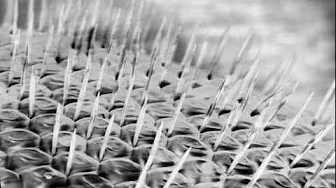
Cambridge University's Under the Microscope is a collection of videos that capture glimpses of the natural and man-made world in stunning close-up and convey the excitement of cutting-edge science in areas that range from beetle eyes to killer T-cells, from nano-wires to fish skeletons.
MovieBox سے آگے بھی entertainment picks
ہم casual games اور short drama پسند کرنے والوں کے لیے partner destinations بھی دکھاتے ہیں۔ کسی بھی تجربے کو ایک ٹیپ میں کھولیں۔
آپ کو یہ بھی پسند آ سکتا ہے
KS2 Drama
Signal in catalog
Learn English With Disney Movies
Signal in catalog
English lessons for kids - My English teacher
Signal in catalog
Nursery Rhymes | Words & Sounds
Signal in catalog
JS 3 Mathematics
Signal in catalog
SS 2 Physical
Signal in catalog
BabyBus Best Nursery Rhymes, Kids Songs, and Cartoon for Kids!
Signal in catalog
JS 1 Science & Technology
Signal in catalog
Learn English with Movies
Signal in catalog
SSS10 Chemistry
Signal in catalog
SS 3 Physical
Signal in catalog
CoComelon #shorts
Signal in catalog
JS 3 Science & Technology
Signal in catalog
JS 1 Science & Technology
Signal in catalog
SS 1 Literature
Signal in catalog
SS 1 Business & Finance
Signal in catalog
Happy Holidays from Netflix Jr!
Signal in catalog
Learn With Ms Rachel - Learn To Talk - Baby, Toddler and Preschool Learning
Signal in catalog
Learn Christmas English with TV Series and Movies
Signal in catalog
Learn English with Music
Signal in catalog
Learn To Talk with Ms Rachel
Signal in catalog
KS2 Spanish
Signal in catalog
KS4 Maths
Signal in catalog
KS1 Religious Education
Signal in catalog
تبصرے
10 تبصرے
In celebration of over a million views of our Under the Microscope videos we have put together this ambient audio visual montage. Thank you for sharing the videos, discussing the science behind them and for your ongoing curiosity. This is a tribute to the many researchers at the University who helped with the creation of the series, but more importantly their ongoing pursuit to unravel the mysteries of our Universe. Music by Intercontinental Music Lab
Cambridge University's Under the Microscope is a collection of videos that show glimpses of the natural and man-made world in stunning close-up. Check out the rest of the series here: Nanowires growing in real time. Each nanowire is roughly 450 atoms wide. Andrew Gamalski: "This video is a bright field environmental transmission electron microscopy video of silicon nanowires growing from gold catalyst particles. The dark crystalline shapes initially present in the video are the gold particles. Disilane, a silicon rich gas, feeds nanowire growth. The solid catalyst particles liquefy after being exposed to the disilane early in the video. Eventually, a solid silicon crystal forms in the now liquid catalyst particle. This crystal continues to grow as silicon is continuously deposited into the catalyst from the disilane gas. The new silicon crystal's diameter is restricted by the size of the gold catalyst. This means the silicon can grow in one direction only, forming a nanowire." Video co
Dr Andrew Gillis explains how an elephant fish embryo lives off a large yellow yolk sack for 7 to 10 months before hatching out as a fish. Cambridge University's Under the Microscope is a collection of videos that show glimpses of the natural and man-made world in stunning close-up. Check out the rest of the series here: Dr Gillis: "This is a picture of an elephant fish embryo. Elephant fish are cartilaginous fishes, and are distant cousins of sharks, skates and stingrays. The elephant fish lives in deep water off the coasts of Australia and New Zealand, but migrates annually into shallow coastal bays to lay their eggs. I study the embryonic development of elephant fish, by collecting their eggs by SCUBA diving at their egg-laying grounds. Normally, an elephant fish embryo will live in their egg and feed off of their yolk supply for 7 to 10 months before hatching out as a completely self-sufficient juvenile. However, these embryos may also be cultured outside of their egg cases, as see
Cambridge University's Under the Microscope is a collection of videos that show glimpses of the natural and man-made world in stunning close-up. Check out the rest of the series here: PhD student Paola Cognigni shows us this beautiful image of a fruit fly's brain and gut. Paola Cognigni: "This video shows the anatomical and functional connection between the brain and the gut in the fruit fly, Drosophila melanogaster. This work is carried out in Dr Irene Miguel-Aliaga's lab in the Department of Zoology as part of a research project that aims to find and explain the interactions between internal organs and their importance in growth and health." The brain is about 700 microns wide: about the size of a pencil tip. The image was taken on the Zoology Dept Imaging Facility on a Leica SP5 confocal system. More info and images: Music by Intercontinental Music Lab
Matthew Kuo tells us how tiny worm faecal pellets affect how oil pipelines sit on the seabed. Cambridge University's Under the Microscope is a collection of videos that show glimpses of the natural and man-made world in stunning close-up. Check out the rest of the series here: Matthew Kuo: "I have a research interest in the geotechnical behaviour and biological origin of deep ocean clay crusts. These crusts are found in many areas that are of particular importance to offshore oil and gas developments, including the Gulf of Guinea, Gulf of Mexico and the Mediterranean Sea. I have discovered that sediments from these areas contain millions of tiny faecal pellets that have been produced by burrowing invertebrates (worms). These pellets, whose abundance in the sediment may range from 30% to 60% by dry mass, are robust and much stronger than undigested material. Their presence and mechanical behaviour can therefore explain the existence of the observed crusts. This video shows several pelle
This is a beautiful image of human brain cells, which can now be grown from adult skin cells. Cambridge University's Under the Microscope is a collection of videos that show glimpses of the natural and man-made world in stunning close-up. Check out the rest of the series here: Yichen Shi: "Brain neural stem cells derived from human skin cells: these stem cells express typical marker genes of brain neocortical stem cells, such as Pax6 (Red fluorescent labeled), and form a rosette structure resembling the transection of the neural tube." The entire image is about 250 μm across (a really thick bit of human hair). More info: Picture taken by Yichen Shi in the Livesey Lab Voice over by Fred Lewsey. Music by Peter Nickalls:
In this video Dr Sungjune Jung shows us the fluid structures produced by the impact of two liquid jets. Cambridge University's Under the Microscope is a collection of videos that show glimpses of the natural and man-made world in stunning close-up. Check out the rest of the series here: Dr Jung: "This video shows the evolution of the flow structures generated from the collision of two liquid jets each with a radius of 420um. The jets were ejected from parallel cylindrical nozzles with an internal diameter of 0.85mm. The collision of the jets resulted in various systems of behaviour which depend on the jet velocities and the liquid properties. We focus on the system where the impinging jets form a liquid sheet which then breaks up into a regular succession of ligaments and droplets, a so-called "fishbone" pattern. This high-speed imaging reveals a fish-like formation for the fluid: the oval sheet with rims correspond to the fish head, the drops on thin ligaments to its body, and bigger
(Watch in 720p if possible) Here we can see the underside of mouse tail skin. Cambridge University's Under the Microscope is a collection of videos that show glimpses of the natural and man-made world in stunning close-up. Check out the rest of the series here: Claire Cox: "The epidermis, which is the outer layer of mammalian skin, is maintained by numerous stem cell populations. The identification of the factors involved in controlling these populations and thus epidermal maintenance is highly valuable. Not only will it provide information as to how a complex tissue is organised and controlled, the principles that are learnt can be applied to other tissues. Through the work that I am completing, I hope that I can also gain a perspective as to what goes wrong in disease processes such as skin cancer. Skin cancer is one of the most prevalent cancers in the world, and understanding what goes wrong and the factors involved could potentially lead to new ideas as to prevention and treatment
Dr Andrew Gillis shows us an embryonic skate head and explains how the red denticles dotted all over it have very similar properties to human teeth. Cambridge University's Under the Microscope is a collection of videos that show glimpses of the natural and man-made world in stunning close-up. Check out the rest of the series here: Dr Gillis: "This is a picture of the head of an embryonic skate (Leucoraja erinacea). A skate is a cartilaginous fish, closely related to sharks and stingrays. This embryo has been stained with dyes that colour the skeleton - cartilage is blue, and mineralised tissue is red - and then cleared with chemicals to make it transparent. The result is a specimen that shows the complex shape and arrangement of different skeletal tissues during embryonic development. I use this staining procedure to visualise the skeleton following experimental manipulation. This allows me to investigate how different genes and proteins are involved in controlling the formation and gr
Matt Benton shows us nuclei moving inside a beetle egg as a beetle embryo forms. Cambridge University's Under the Microscope is a collection of videos that show glimpses of the natural and man-made world in stunning close-up. Check out the rest of the series here: Matt Benton: "For my PhD I am studying the embryonic development of the beetle, Tribolium castaneum. During development in this beetle, a large number cells must move together at a certain location of the egg to form the embryo proper. At the same time, other cells move to overlap the forming embryo, to protect it and help it grow. Currently, we only have a basic understanding of how these different groups of cells move. In my work I am trying to extend this understanding, and to learn how the movements of different groups of cells are controlled and coordinated. Together with the group of Michalis Averof, I am developing methods to allow the movements of these cells to be seen in live embryos. The beetle shown in this video