
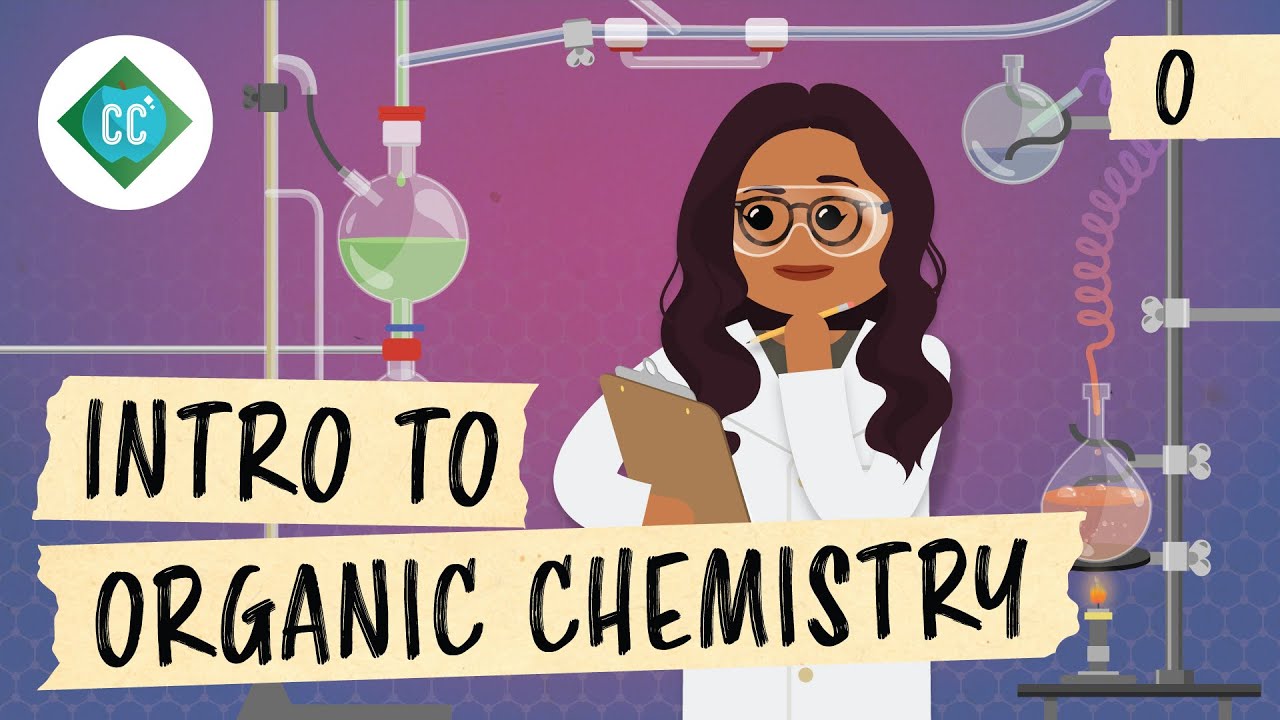
In 50 episodes, Dr. Deboki Chakravarti will teach you organic chemistry. This course is based on sophomore-level college material, covering topics from Organic Chemistry I and II. It was developed with 9 reference texts and journal articles on specialized topics in organic chemistry, in particular: Organic Chemistry texts by Brown, Foote, Iverson and Ansyln (8th ed.); Clayden, Greeves and Warren (2nd ed.); McMurry (9th ed.) By the end of this course, you will be able to: * Recognize and name the major functional groups in organic compounds * Understand the influence of molecular structure and conformation on chemical properties and reactivity * Identify the possible reactions for a given organic compound and select reasonable reaction mechanisms given the reactant structure and functional groups * Sketch a mechanism for an organic reaction, showing valid arrow-pushing and formal charges * Develop and compare synthetic routes to a target molecule from a starting compound * Interpret spectra (e.g. IR, NMR, MS, UV/vis) and understand how they are used in structure determination * Connect the chemical properties of organic compounds to their real-world applications (e.g. in polymers, medicine, and biochemistry).
MovieBox के बाहर भी एंटरटेनमेंट पिक्स
हम casual games और short drama पसंद करने वालों के लिए partner destinations भी दिखाते हैं। किसी भी अनुभव को एक टैप में खोलें।
आपको ये भी पसंद आ सकते हैं
Princess Songs and Nursery Rhymes for Babies - CoComelon Kids Songs
Signal in catalog
ChuChu & Friends in Storytime Adventures - ChuChu TV
Signal in catalog
Mix - Every CoComelon Wheels on the Bus Ever!
Signal in catalog
Alphabet ABC Phonics Series (From A to Z) in HD
Signal in catalog
Chemistry
Signal in catalog
Kids Songs by CoComelon
Signal in catalog
CoComelon
Signal in catalog
Alphabet (ABC) Songs by CoComelon
Signal in catalog
Organic Chemistry
Signal in catalog
SS 1 Chemistry
Signal in catalog
Organic Chemistry: Naming organic compounds
Signal in catalog
Quantitative Aspects of Chemical Change grade 11
Signal in catalog
Acids and Bases Grade 12
Signal in catalog
Class 12 Chemistry (By Hemant Sir) | Complete CBSE Course | All Chapters Available | Useful for IIT-JEE/NEET | Session 2024-25
Signal in catalog
SSS 1 Chemistry
Signal in catalog
Grade 6 Science Q1 Ep8: Separating Mixtures through Evaporation
Signal in catalog
Oxydoréduction (1spé)
Signal in catalog
SS 3 Physics
Signal in catalog
SS 2 Chemistry
Signal in catalog
SS 3 Chemistry
Signal in catalog
KS3 Chemistry
Signal in catalog
Year 10 Chemistry
Signal in catalog
Electrochemistry
Signal in catalog
Physical and Chemical Change Grade 10
Signal in catalog
टिप्पणियाँ
10 टिप्पणियाँ
These days, we don't have to worry too much about meeting an early demise from ulcers, breaks in the stomach lining that could be fatal back in the early 1900s. This is because we have medicines to treat them, like proton pump inhibitors! In this final episode of Crash Course Organic Chemistry, we'll look at medicinal chemistry by breaking down how penicillin fights bacteria, how proteins are made both in the body and in the lab, and we'll finally finish our synthesis of penicillin V and complete our Mold Medicine Map! Hopefully this series has shown you the many ways organic chemistry is all around us and how it can help us to better understand ourselves, and improve our world! Episode Sources: Patrick, G. L. (2013). An introduction to medicinal chemistry. Oxford university press. Vollmer, W., Blanot, D., & De Pedro, M. A. (2008). Peptidoglycan structure and architecture. FEMS microbiology reviews, 32(2), 149-167. Sauvage, E., Duez, C., Herman, R., Kerff, F., Petrella, S., Anderson,
These days, we don't have to worry too much about meeting an early demise from ulcers, breaks in the stomach lining that could be fatal back in the early 1900s. This is because we have medicines to treat them, like proton pump inhibitors! In this final episode of Crash Course Organic Chemistry, we'll look at medicinal chemistry by breaking down how penicillin fights bacteria, how proteins are made both in the body and in the lab, and we'll finally finish our synthesis of penicillin V and complete our Mold Medicine Map! Hopefully this series has shown you the many ways organic chemistry is all around us and how it can help us to better understand ourselves, and improve our world! Episode Sources: Patrick, G. L. (2013). An introduction to medicinal chemistry. Oxford university press. Vollmer, W., Blanot, D., & De Pedro, M. A. (2008). Peptidoglycan structure and architecture. FEMS microbiology reviews, 32(2), 149-167. Sauvage, E., Duez, C., Herman, R., Kerff, F., Petrella, S., Anderson,
These days, we don't have to worry too much about meeting an early demise from ulcers, breaks in the stomach lining that could be fatal back in the early 1900s. This is because we have medicines to treat them, like proton pump inhibitors! In this final episode of Crash Course Organic Chemistry, we'll look at medicinal chemistry by breaking down how penicillin fights bacteria, how proteins are made both in the body and in the lab, and we'll finally finish our synthesis of penicillin V and complete our Mold Medicine Map! Hopefully this series has shown you the many ways organic chemistry is all around us and how it can help us to better understand ourselves, and improve our world! Episode Sources: Patrick, G. L. (2013). An introduction to medicinal chemistry. Oxford university press. Vollmer, W., Blanot, D., & De Pedro, M. A. (2008). Peptidoglycan structure and architecture. FEMS microbiology reviews, 32(2), 149-167. Sauvage, E., Duez, C., Herman, R., Kerff, F., Petrella, S., Anderson,
These days, we don't have to worry too much about meeting an early demise from ulcers, breaks in the stomach lining that could be fatal back in the early 1900s. This is because we have medicines to treat them, like proton pump inhibitors! In this final episode of Crash Course Organic Chemistry, we'll look at medicinal chemistry by breaking down how penicillin fights bacteria, how proteins are made both in the body and in the lab, and we'll finally finish our synthesis of penicillin V and complete our Mold Medicine Map! Hopefully this series has shown you the many ways organic chemistry is all around us and how it can help us to better understand ourselves, and improve our world! Episode Sources: Patrick, G. L. (2013). An introduction to medicinal chemistry. Oxford university press. Vollmer, W., Blanot, D., & De Pedro, M. A. (2008). Peptidoglycan structure and architecture. FEMS microbiology reviews, 32(2), 149-167. Sauvage, E., Duez, C., Herman, R., Kerff, F., Petrella, S., Anderson,
You might think a self regulating factory sounds pretty unbelievable, but that’s pretty much exactly how our bodies work! Our bodies are full of regulatory mechanisms that keep all the organic molecules we need to live in balance. In this episode of Crash Course Organic Chemistry, we’ll look at the building blocks that form these biological polymers, including carbohydrates, proteins, and DNA! Episode Sources: Garrett, R. H., & Grisham, C. M. (2016). Biochemistry. Cengage Learning. Appling, Dean R., Anthony-Cahill, Spencer J., Mathews, Christopher K.. (2016). Biochemistry: concepts and connections. Essex: Pearson. PDB IDs (available at https://www.rcsb.org/): • 1BNA, 6TNA, 3MQ7, 7BJK, 6EC0, 2D3H, 1UBQ, 1BBB, 3FGU Series Sources: Brown, W. H., Iverson, B. L., Ansyln, E. V., Foote, C., Organic Chemistry; 8th ed.; Cengage Learning, Boston, 2018. Bruice, P. Y., Organic Chemistry, 7th ed.; Pearson Education, Inc., United States, 2014. Clayden, J., Greeves, N., Warren., S., Organic Chemis
You might think a self regulating factory sounds pretty unbelievable, but that’s pretty much exactly how our bodies work! Our bodies are full of regulatory mechanisms that keep all the organic molecules we need to live in balance. In this episode of Crash Course Organic Chemistry, we’ll look at the building blocks that form these biological polymers, including carbohydrates, proteins, and DNA! Episode Sources: Garrett, R. H., & Grisham, C. M. (2016). Biochemistry. Cengage Learning. Appling, Dean R., Anthony-Cahill, Spencer J., Mathews, Christopher K.. (2016). Biochemistry: concepts and connections. Essex: Pearson. PDB IDs (available at https://www.rcsb.org/): • 1BNA, 6TNA, 3MQ7, 7BJK, 6EC0, 2D3H, 1UBQ, 1BBB, 3FGU Series Sources: Brown, W. H., Iverson, B. L., Ansyln, E. V., Foote, C., Organic Chemistry; 8th ed.; Cengage Learning, Boston, 2018. Bruice, P. Y., Organic Chemistry, 7th ed.; Pearson Education, Inc., United States, 2014. Clayden, J., Greeves, N., Warren., S., Organic Chemis
You might think a self regulating factory sounds pretty unbelievable, but that’s pretty much exactly how our bodies work! Our bodies are full of regulatory mechanisms that keep all the organic molecules we need to live in balance. In this episode of Crash Course Organic Chemistry, we’ll look at the building blocks that form these biological polymers, including carbohydrates, proteins, and DNA! Episode Sources: Garrett, R. H., & Grisham, C. M. (2016). Biochemistry. Cengage Learning. Appling, Dean R., Anthony-Cahill, Spencer J., Mathews, Christopher K.. (2016). Biochemistry: concepts and connections. Essex: Pearson. PDB IDs (available at https://www.rcsb.org/): • 1BNA, 6TNA, 3MQ7, 7BJK, 6EC0, 2D3H, 1UBQ, 1BBB, 3FGU Series Sources: Brown, W. H., Iverson, B. L., Ansyln, E. V., Foote, C., Organic Chemistry; 8th ed.; Cengage Learning, Boston, 2018. Bruice, P. Y., Organic Chemistry, 7th ed.; Pearson Education, Inc., United States, 2014. Clayden, J., Greeves, N., Warren., S., Organic Chemis
Although we've spent a lot of time in this series looking at human-made organic chemicals, the term "organic chemistry" was originally used to describe molecules isolated from living things. In this episode of Crash Course Organic Chemistry, we're going back to our roots to learn more about the best synthetic chemists: living things. We'll look at the biochemical building blocks of life from the nitrogenous bases, sugars, and phosphate groups that make up DNA and RNA, to amino acids and lipids, and we'll learn how to convert between Fischer and Haworth projections of carbohydrates. Series Sources: Brown, W. H., Iverson, B. L., Ansyln, E. V., Foote, C., Organic Chemistry; 8th ed.; Cengage Learning, Boston, 2018. Bruice, P. Y., Organic Chemistry, 7th ed.; Pearson Education, Inc., United States, 2014. Clayden, J., Greeves, N., Warren., S., Organic Chemistry, 2nd ed.; Oxford University Press, New York, 2012. Jones Jr., M.; Fleming, S. A., Organic Chemistry, 5th ed.; W. W. Norton & Company
Although we've spent a lot of time in this series looking at human-made organic chemicals, the term "organic chemistry" was originally used to describe molecules isolated from living things. In this episode of Crash Course Organic Chemistry, we're going back to our roots to learn more about the best synthetic chemists: living things. We'll look at the biochemical building blocks of life from the nitrogenous bases, sugars, and phosphate groups that make up DNA and RNA, to amino acids and lipids, and we'll learn how to convert between Fischer and Haworth projections of carbohydrates. Series Sources: Brown, W. H., Iverson, B. L., Ansyln, E. V., Foote, C., Organic Chemistry; 8th ed.; Cengage Learning, Boston, 2018. Bruice, P. Y., Organic Chemistry, 7th ed.; Pearson Education, Inc., United States, 2014. Clayden, J., Greeves, N., Warren., S., Organic Chemistry, 2nd ed.; Oxford University Press, New York, 2012. Jones Jr., M.; Fleming, S. A., Organic Chemistry, 5th ed.; W. W. Norton & Company
Although we've spent a lot of time in this series looking at human-made organic chemicals, the term "organic chemistry" was originally used to describe molecules isolated from living things. In this episode of Crash Course Organic Chemistry, we're going back to our roots to learn more about the best synthetic chemists: living things. We'll look at the biochemical building blocks of life from the nitrogenous bases, sugars, and phosphate groups that make up DNA and RNA, to amino acids and lipids, and we'll learn how to convert between Fischer and Haworth projections of carbohydrates. Series Sources: Brown, W. H., Iverson, B. L., Ansyln, E. V., Foote, C., Organic Chemistry; 8th ed.; Cengage Learning, Boston, 2018. Bruice, P. Y., Organic Chemistry, 7th ed.; Pearson Education, Inc., United States, 2014. Clayden, J., Greeves, N., Warren., S., Organic Chemistry, 2nd ed.; Oxford University Press, New York, 2012. Jones Jr., M.; Fleming, S. A., Organic Chemistry, 5th ed.; W. W. Norton & Company